
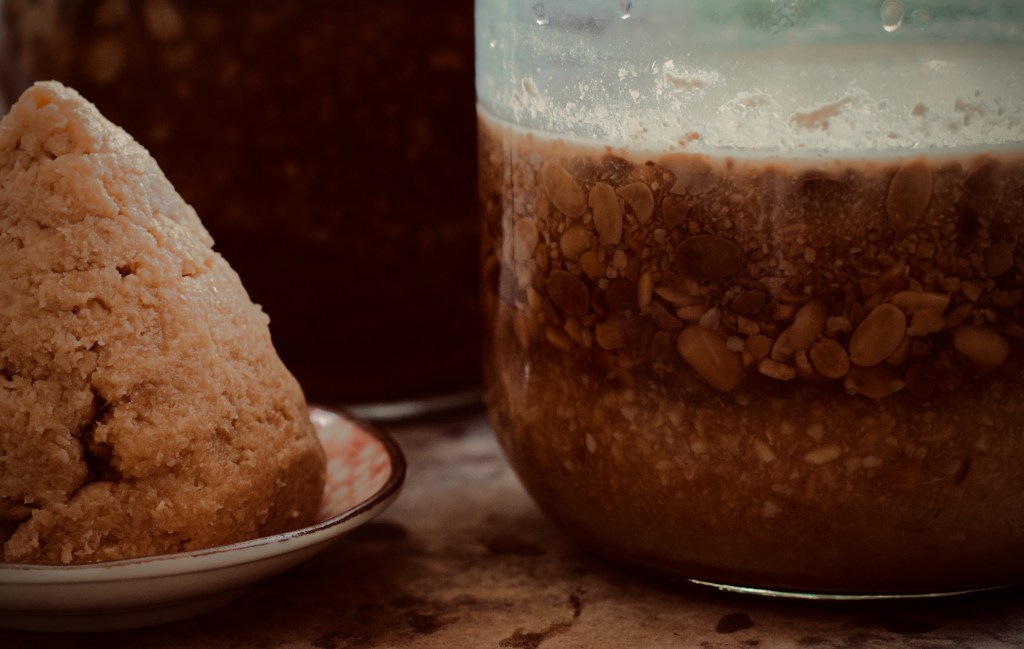
Fermented soybean originated from China during the 2nd century BCE. By the year 200 CE, it had become a staple condiment. Though losing its place to soy sauce by the year 1600 in China, thanks to Buddhist monks, its popularity had spread across East and Southeast Asia and westward as far as North East India.
Fermented soybean can be grouped into two categories. One is a quick fermentation, where the soybean is cooked to tender, then either let to ferment by itself or inoculated with mold spores for 3-4 days. Some of these include Tempeh in Indonesia, Tua Nao Muh in Southeast Asia, and Tungrymbai in North East India. The other category requires any time from 3 months to 3 years. Some of these include various Miso pastes in Japan, Doenjang in Korea, and Tương in Vietnam. At minimum, they involve two stages of fermentation. First, Aspergillus mold is grown on cooked grains or soybeans. Then, a salt brine is added along with more cooked soybeans. The molds die in the brine, but their enzymes continue to work. Meanwhile, microbes thriving in the briny environment such as lactic acid bacteria and yeasts add depth of flavor to the soybean paste.
The mildest and most appreciated fermented soybean product in the United States is white miso. Making it involves a basic two-stage fermentation process: one week to develop white Aspergillus mold on cooked plain rice, then add cooked soybean and let ferment for 6-9 months. Making Korea’s Doenjang is an elaborate 3-stage fermentation process: first, mold development on the cooked soybean, second, add salt brine and flavor enhancers, and then a final fermentation after isolating the soybean paste from the brine.
Tương is a regional specialty of Northern Vietnam. Originating from the town Bần of Hưng Yên province, tương Bần has become a household name cited often in folk poetry and idioms. Tương making also involves 3 stages of fermentation, but the first two stages can be done simultaneously and only 3 months are needed, leveraging the region’s hot and sunny climate.
| Mold, Grown on rice | Mold, Grown on soybean | |
| Soybean, Steamed | White miso: white mold grown on white rice: 7 days, stage-2 fermentation: 6 to 9 months. | Doenjang: mold grown on soybean: 2 months, stage-2 fermentation with brine and flavor enhancers: 3 months, stage-3 fermentation: 6 months. Mame Miso/Hatcho: one stage fermentation: 2 to 3 years. |
| Soybean, Roasted | Tương: stage-1 fermentation (soybean in water): 10 days, stage-2 green mold grown on sweet rice: 7 days, stage-3 fermentation: 3 months. | X |
In this experiment, I aimed for two fermented soybean products – white miso and tương. While white miso is made by growing white mold on cooked white rice, tương is made with green Aspergillus mold on sweet rice, which lends it a dark brown color. Furthermore, fermenting the roasted soybean in water separately gives tương its funky distinctive flavor. Unlike miso, heat and sunlight are essential in making tương, so the best 3 months to make it should be the sunniest and hottest months of the year.
To make white miso, I used the recipe on food52, which follows Nancy Singleton Hachisu’s Miso Recipe. The weight ratio of salt to grain and legume for white miso is 400 : 2000 or 20%. A folk poem describing the recipe for tương gives a similar weight ratio at 22%:
“Xôi giặt ba ngày, đậu liền rang,
Chín tương hai muối ngọt như đàng.”
[Mold the sweet rice, then after 3 days, roast the soybean,
9 parts paste : 2 parts salt will be sweet like sugar.]
When it comes to how much salt, the goal is just right for taste, but adequate to prevent harmful bacterias from growing. Taking water into consideration, I started with a ratio of 50%. As I had previously written about growing both white and green Aspergillus mold, I also made tương with both molds, for some fun and comparison.
Tương Recipe
400 gr soybeans, 30-min soaked
2 liters of water, boiled and let cooled
400 gr sweet rice, overnight soaked and steamed until cooked
½ tsp white or green Aspergillus mold spores
400 gr salt
1. Ferment soybean: Drain and roast the soybeans in single layers for 30 min @ 325F. They should be dry, crunchy, and fragrant, but not burnt or bitter. Then grind the soybeans to break them into small bits, add the ground soybeans and 2 liters of water into a sterilized jar, and stir to mix well. Cover the jar with a cloth and let it sit under sunlight for 10 days. Stir the soybean mixture daily in the morning.
Note: Within 2 days, there should be frothy bubbles atop. Gradually, the soybean should smell pungent like a funky cheese. Use a glass jar to take advantage of sunlight. Per my observation, the soybean did not ferment properly in the ceramic jar. Rather than smelling funky, it smelled like soured tofu water.

2. Grow mold: Spread thinly the cooked sweet rice onto a tray lined with a linen towel and sprinkle the mold spores atop with your fingers. Cover the tray tightly with cling film, poke a couple of finger-sized holes through it, and leave it in the oven to grow the mold. Keep the oven light on for a few hours every morning. The optimal warm temperature required for incubation is between 86°F (30°C) and 95°F (35°C). Within 3 days, there should be mold growing on the rice grains. Stir and crumple to spread the mold evenly, allow up to another 4 days for the mold to grow fully. Store in a plastic bag and refrigerate until ready to use, up to 2 weeks.
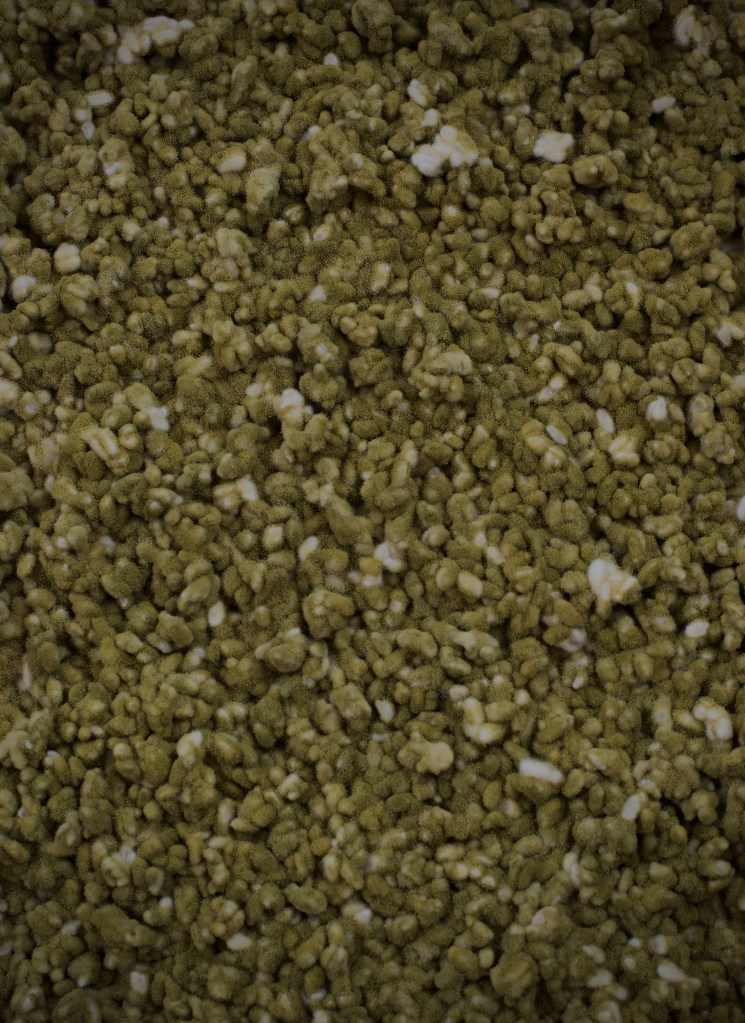
Stage 2 – Day 7
3. Final fermentation: After 10 days, add salt and the finely ground moldy rice to the fermented soybean liquid. Stir the mixture daily for the next 3 days. Then cover the jar’s opening with cling film, close the lid, and let it ferment outdoors, under sunlight, for 3 months. However, during days above 100F, keep it in a shaded corner or bring it indoors until outside temperature cools down again.
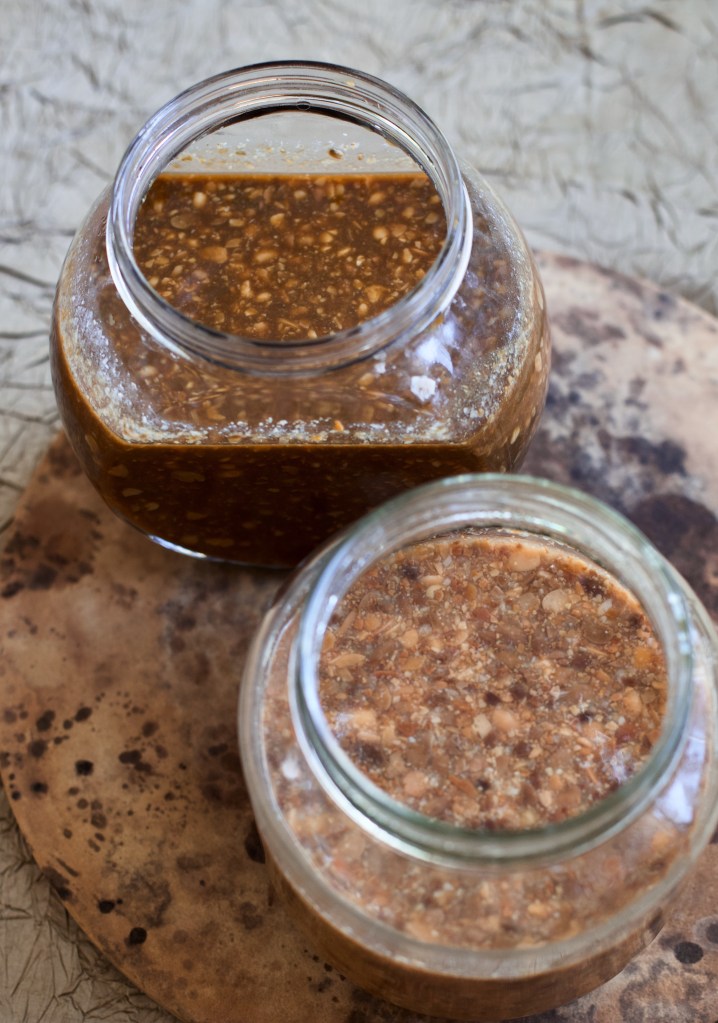
For the end product, the soybean pieces should be tender that they yield to mush under your fingers. Grinding the roasted soybean more finely does help. Tương should taste sharp and pungent, sweet and salty. For next summer, I would use less salt, perhaps at 30% ratio or less. Tương is not pasty like miso, rather a thick slurry. Less water should result in a denser texture. To reduce the weight ratio of water : paste to 15 : 8, I would employ a salt to paste ratio of 22%.
“Anh đi anh nhớ quê nhà,
Nhớ canh rau muống, nhớ cà dầm tương.
Nhớ ai dãi nắng dầm sương,
Nhớ ai tát nước bên đường hôm mai.”
[I’m far away, and I miss home,
Morning glory, berries in tương.
Who’s drenched in sunlight, basted in dew,
moving water by the earthen bund.]
I hardly eat berries basted in tương any more. Now I splash it onto stir-fries or blend it with jaggery, lemon juice, chili, and ginger. And its full-bodied, umami-filled flavor makes a fantastic marinade for grilled meat.
 hardlyplaying.blog
One response to “Fermented Soybean”
[…] Who’s drenched in sunlight, basted in dew, moving water by the earthen bund.], where tương is fermented soybean, the Vietnamese version of […]
LikeLike