
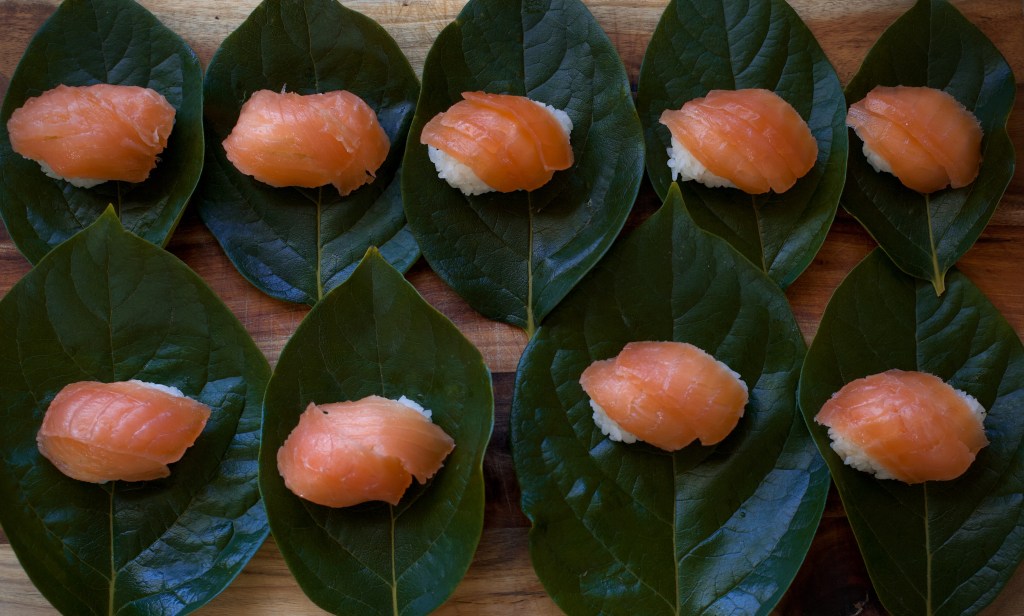
To preserve fresh fish by fermenting it with carbohydrates has been a long-time tradition for both Northern Europe and Asia regions. The original form of sushi was narezushi, made with rice and carp. As sushi means to sour, bacteria digests rice to produce acids to not only protect the fish against spoilage, but also to soften its texture and to give it tartness. In Scandinavia, gravlax means buried fish. The fish is wrapped in birch bark and buried in the ground. Bacterias digest the bark and produce lactic fermentation to acidify the fish surface. The fish’s enzymes then break down its own protein and fat for a buttery texture and cheesy flavor. [source: On Food and Cooking by Harold McGee]
While today’s gravlax is made by dry-salting the fish and then refrigerating it for a few days, modern-day sushi chooses fresh fish and retains its sour flavor by adding vinegar to the cooked rice instead. Combining the two methods, sushi can be done with salt-cured raw fish instead of fresh fish.
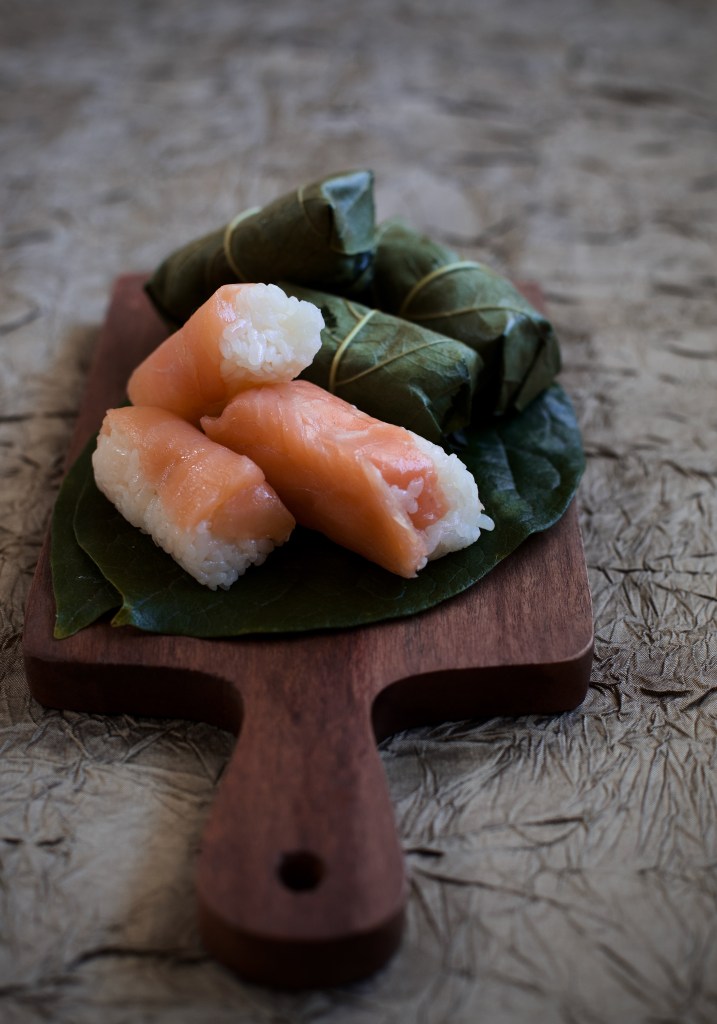
Near Tokyo is the town of Nara. It is famous for its deers who eat from human hands as if domesticated, but also for its sushi wrapped in persimmon leaves. The sushi is done old-style where the rice is left to ferment the fish to soften while the persimmon leaves have natural antibacterial properties to help preserve it. In In Praise of Shadows, Jun’ichirō Tanizaki wrote, “I learned of this dish from a friend who had been to Yoshino and found it so exceptionally good that he took the trouble to learn how to make it – but if you have the persimmon leaves and salted salmon it can be made anywhere….The oil of the salmon and the slight hint of salt give just the proper touch of seasoning to the rice, and the salmon becomes as soft as if it were fresh – the flavor is indescribable, and far better than the sushi one gets in Tokyo. I have become so fond of it that I ate almost nothing else this summer. What impressed me, however, was that this superb method of preparing salted salmon was the invention of poor mountain people. Yet a sampling of the various regional cuisines suggests that in our day country people have far more discriminating palates than city people, and that in this respect they enjoy luxuries we cannot begin to imagine.” If he were intimately familiar with the Europeans, perhaps he, like the Scandinavians, would have described its flavor as cheesy with a buttery texture.
Salt cured salmon: ensure that the fish is previously frozen and thawed gently in the fridge. For 6 oz of fish, mix 2 tbsp of salt, 2 tbsp of sugar, and ½ tbsp of sake into a paste, enough to cover the piece of fish completely. Wash, dry the fish, and place it on a large piece of cling film. Spread the salt paste onto it to cover fully, then wrap it up with the cling film. Place a heavy object on it to press out some of the liquid in order to firm up the flesh. Refrigerate for 24 hours, then wash off the salt paste, dry, and slice thinly.
Sushi rice: add a piece of dried kelp, aka kombu, and some sake to ¾ cup of rice and a scant ¾ cup of water and let it soak for 30 minutes before cooking. Once cooked, fan it out onto a plate and mix in 2 tbsp of seasoned rice vinegar while it is still warm.
To wrap the sushi in persimmon leaves, you will need a way to compress the sushi pieces with a weight. A 4×5.5-inch tofu mould works. 6 pieces of sushi fit neatly into one layer within the mould, so the total number of sushi pieces should be in multiplication of 6. They are ready to be eaten the next day.


One response to “Salt Cured”
[…] and drying, such as salt cured fish roe which has been done across cultures for centuries. Quick curing, made ready within a few days with salt and sugar, is another popular method. Then there are […]
LikeLike