
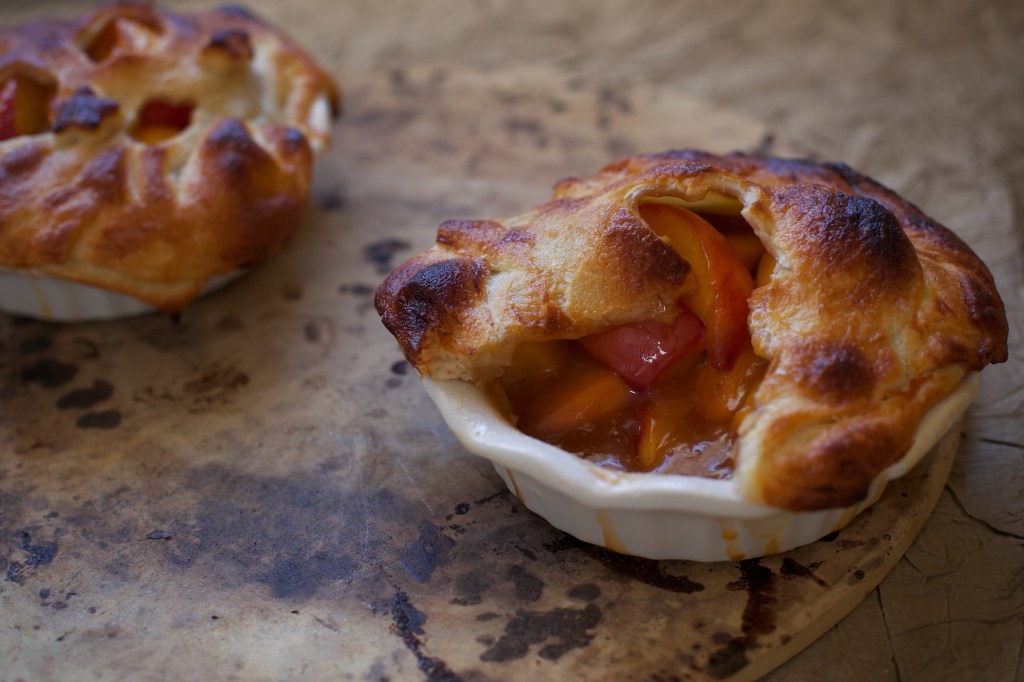
It’s said that making pies is not easy, but if you’ve gotten proficient at puff pastry, you’ll see that it’s just another piece of pie. Call it pie in America, tart in France, or crostata in Italy, it’s all about a sweet or savory filling studded by a flaky pastry dough.
There is more than one way to make a pie crust, mostly having to do with whether one wants it tender, crisp, or flaky, and the corresponding choice of fat used in the dough. Not only butter, but lard, shortening, and even vegetable oil can be utilized, though vegetable oil will not get you a flaky pie crust. Much thought goes into how to faster achieve a flaky pastry with less fuss. Butter, if too warm, will melt into the flour and produce no flakes, but if too cold, will fracture during rolling. Both lard and shortening make crisp, flaky crust and are easier to handle, as they are solid at room temperature and remain firm in the oven long enough for the dough to set. Good-quality lard is hard to find, thus shortening was a popular choice for a flaky pie dough until recently, when hydrogenated fat fell out of favors.
Using sour cream in a buttered dough is the less fussy answer to a flaky pastry. However, the trade-off is the addition of much more fat, so the pastry will be flaky but extra heavy. The need to maintain the butter just right translates to time. Employing the puff pastry method requires multiple cold rests to keep it from getting too soft when it’s being worked. This “rough puff” pastry recipe adapted from Zuni Cafe incorporates butter into the dough at détrempe and omit beurrage.
DAY 1:
Détrempe:
1 cup AP wheat flour, plus extra for dusting
¼ heaping tsp of vinegar (to prevent gluten from developing too much strength)
One 4-oz stick cold butter
5 tbsp ice water
½ tsp salt
Filling: 3 firm fresh apricots cut into 8-16 slices each, a generous pinch of salt, 3 tbsp brown sugar, 1 tbsp dark rum
Stir the salt into the flour and pour it onto the counter. Cut the butter into flat slabs and place them into the pile of flour. Use the fraisage technique to press the butter into the flour with the heel of your hands. Use a dough scraper to scrape in from the edges, lift, and toss the mass of butter pieces and flour, and then press them flat again with your hands. Repeat until there is a lumpy bed.
Add the vinegar and trickle a tbsp of ice water at a time into the mass of flour. Repeat scraping, lifting, and tossing with the dough scraper, then press with your hands to flatten. Fold and repeat until the dough is incorporated and there’s no major dry spot. Pat it into a 4-inch square, wrap in clingfilm, and refrigerate for at least 30 min.
Beurrage: NA
Tourage: Dusting the countertop and the dough with just enough flour to prevent sticking, repeat the steps for tourage in feuilletage for a total of 4 turns, refrigerating for 30 min – 2 hours after the first 2 turns, then overnight after 4 turns.
Filling: Sprinkle the salt onto the fruit slices, then gently macerate them with the brown sugar and rum and let it sit for a few hours. Drain out the juice overnight over a strainer.
DAY 2:
¼ cup of sugar for dusting
Egg wash and 3 tbsp brown sugar for topping
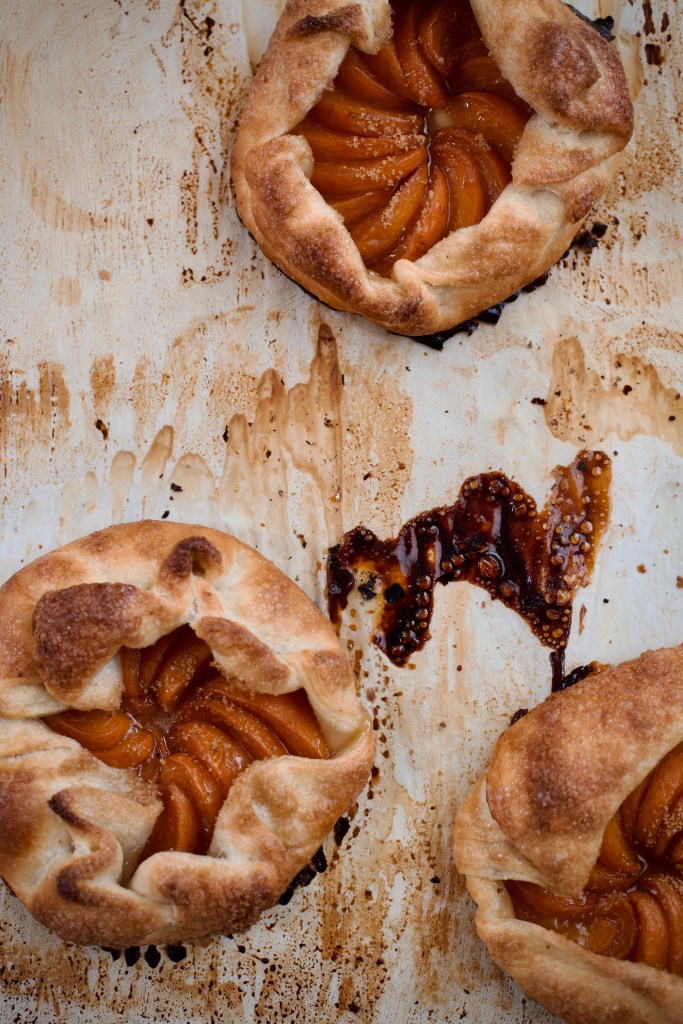
During baking, fruits release more of their own juice and it will spill over and out. Draining the fruit juice over a strainer helps minimize juice spilling. On the stove over medium heat, reduce the remaining juice to a syrup to drizzle over the tarts after they’re done baking if desired.
Dusting the dough generously with sugar, give the paton 2 final turns with a 15 minute freeze rest between turns if needed. Don’t forget to brush the dough with ice water before each fold. Freeze it for 15 minutes, then roll the paton into a long rectangle. Divide the rectangle into 3 squares and place them onto a baking pan lined with parchment paper. Freeze the entire baking pan for another 10 minutes, then roll the squares out as flat as you can, to about ⅛-inch thick.
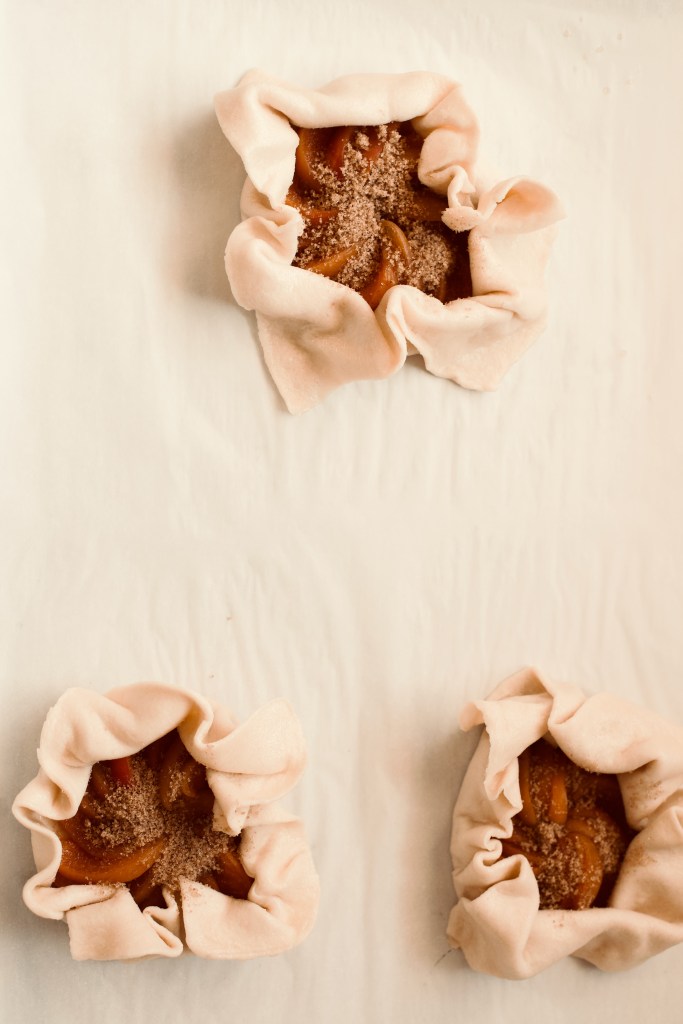
The last freeze takes 5 min and preheat the oven to 425F in the meantime. Arrange the fruit slices into a spin wheel design at the center of each square sheet. Sprinkle the fruit with a 1 tbsp of brown sugar each. Fold over the remaining area of the sheet to cover the fruit partially. Fold each corner of the square back to make a double layer. Brush the dough with egg wash. Double stack the baking pan to prevent burning at the bottom.
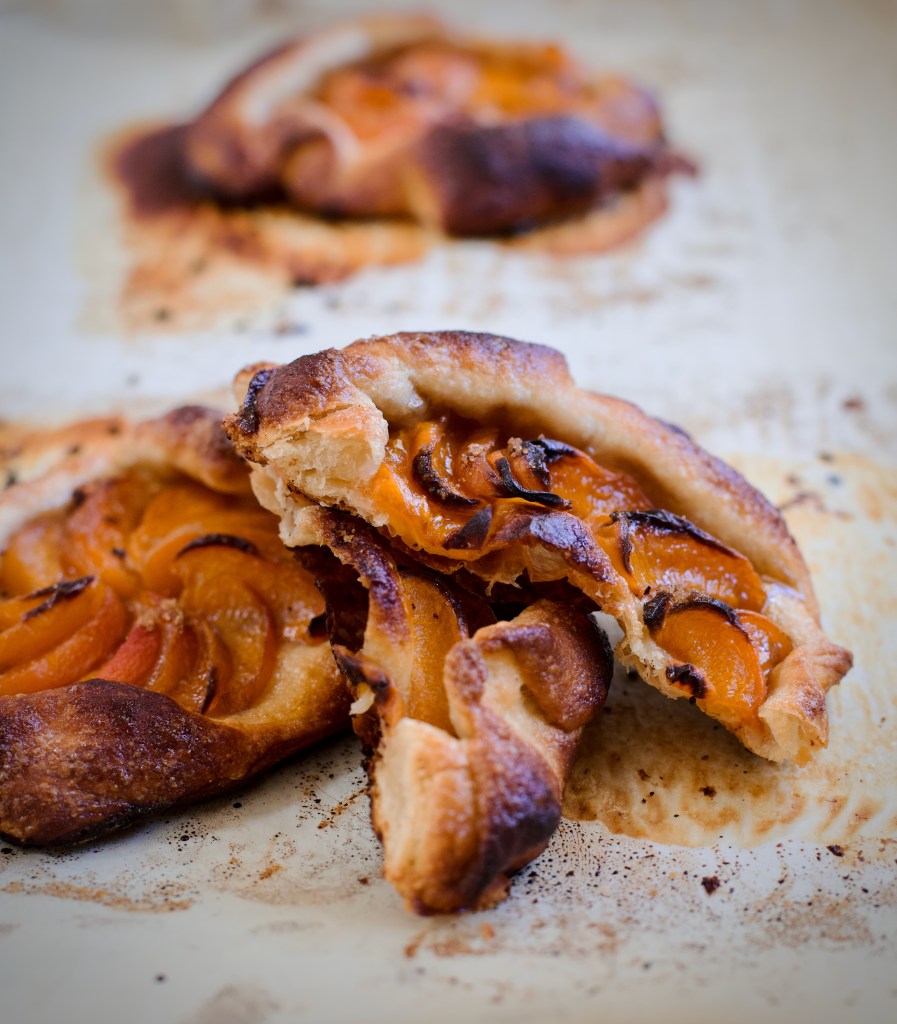
Once the tarts are in the oven, reduce oven temperature to 400F for 40 minutes will make a fully crisp and flaky crust, blistered apricots, and brown patches atop. If you prefer a gorgeous golden crust, bake for 25 minutes at 400F, then lower to 350F for 15 minutes. Consequently, only the outer crust will be crisp and flaky while the inner crust and the fruits will stay squishy. The amount of fruit will also affect crust browning. Reheat frozen tarts at 300F for 20 minutes.
**********************************
**********************************
The pie is different from the tart in that its filling is covered by a second pastry layer, preventing moisture from evaporating during baking. Thus keeping it from being runny is even more important, as fruit shrinkage may cause a gap to the rooftop, or if the pastry dough is so soft that it may collapse or deflate.
So in addition to draining the juice out of the fruits, a thickening starch is usually needed. The challenge is to figure out which starch and how much of it to use for a just-right jelly texture. It depends on which fruits, frozen or fresh, and their textures if fresh. I’ve chosen tapioca starch, as it turns translucent when cooked, but it does make for a gooey jelly. Cornstarch and flour make opaque and cloudy jelly respectively.
Instead of cooking the starch with the rest of the pie during baking, we can reduce the guess work by precooking it, as prescribed by Shirley Corriher in Bake Wise. Precooking to a boil the drained fruit juice and starch causes irreversible changes in the starch so that it does not continue to thicken during baking. It helps prevent boil-over and the fruit filling from becoming pasty or starchy.
Filling: 2 pounds firm fresh yellow peaches, ½ tsp + ¼ tsp salt, 1 cup brown sugar, 2 tbsp dark rum, 5 tbsp tapioca starch, ¼ cup water, ¼ cup sugar, 3 tbsp butter, 1 tbsp corn syrup, 2 tsp vanilla extract, ½ tsp lemon extract
DAY 1: In addition to working the pastry dough, macerate the sliced peaches with ½ tsp of salt, 1 cup of brown sugar, and 2 tbsp of dark rum and let it sit for a few hours, then drain out the juice overnight over a strainer.
DAY 2:
Need: Two 5.5×1-inch pie pans, egg wash, and ¼ cup of sugar for dusting
Whisk 5 tbsp of tapioca starch into ¼ cup of water. Adding water to the drained peach juice to make 1 cup if needed and bring it to a boil, add the ¼ tsp of salt, then whisk in the tapioca starch solution and keep stirring until it comes back to a strong boil. Then add ¼ cup of sugar, stirring constantly until it again comes back to a strong boil. Turn off the fire and add 3 tbsp butter, 1 tbsp corn syrup, 2 tsp vanilla extract, ½ tsp lemon extract. Fold in the fruits and let it cool down, 30 min.
Butter the two pie pans and coat them with graham cracker crumbs. Dusting the dough generously with sugar, give the paton 2 final turns with a 15 minute freeze rest between turns if needed. Don’t forget to brush the dough with ice water before each fold. Freeze it for 15 minutes, then roll the paton into a long rectangle. Divide the pastry dough into 4 squares and roll them out again to flatten while spreading out the corners of each square so it resembles a rough circle. Place the first sheet onto the pie pan, pressing it down the edges while leaving extra to counter shrinkage.
Freeze all pastry sheets, including the pie pans for 5 minutes. Collecting the fruit pieces while leaving much of the jelly behind, pile the fruits into a dome-high mound in the pie pan. Gently place the second sheet over the fruits. Pinch top and bottom of dough rounds firmly together. Trim excess dough with kitchen shears.
Fold the dough under itself so that the edge of the fold is flush with the edge of the pan. Brush it with egg wash, then make slits or cutouts to allow for steam to escape.
Preheat oven with a baking stone to 450F, 25 min. I prefer to eat this warm for the crust to stay flaky. P.S. frozen pie releases even more fruit juice during reheat, thus more starch may be used for a thicker filling. Try ⅓ cup + 1 tbsp of tapioca starch and reheat at 300F for 40 minutes.


One response to “Flakes, III”
[…] Wednesday, I will make the dough for the apple pie. It takes about half a day with a few in-between pauses for cold resting. Perhaps I will use these […]
LikeLike