
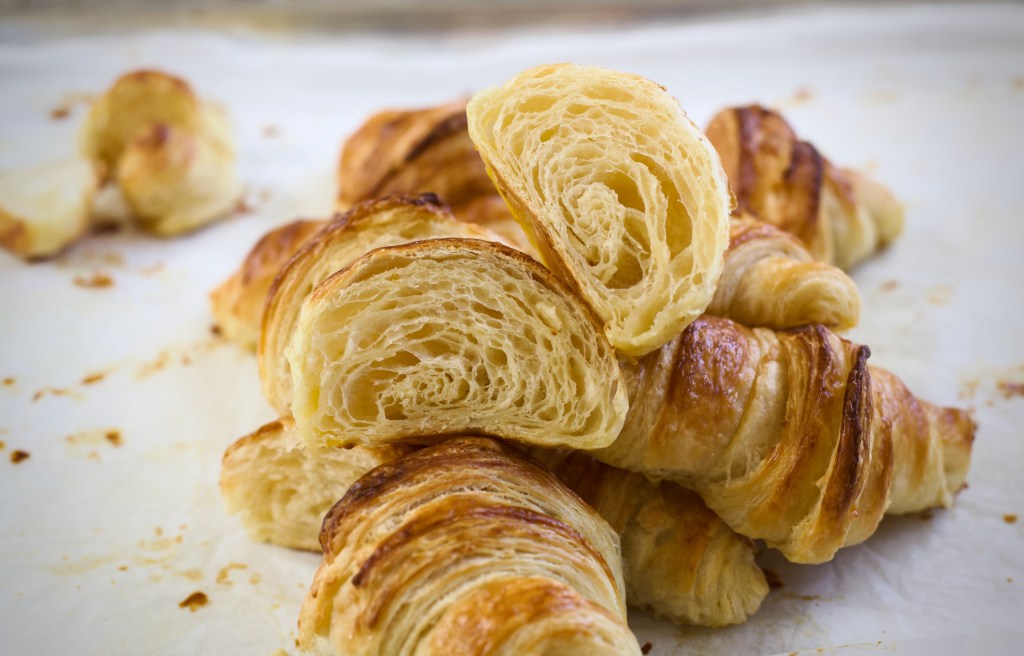
The croissant is butter and flour fermented into crispy, airy, and buttery flakes. It feels magical that a yeasted wheat dough filled with so much butter could rise into such an open crumb and flaky pastry. But it is possible because of lamination. Yeast works between layers of butter, digesting flour to transform layers of dough to become bread-like: sweet, light, and yeasty.
We love the croissant for its open crumb, honeycomb appeal. But until I looked into how to make it, I didn’t realize that there is a compromise between how it looks and how it tastes. A more open and flaky honeycomb structure means a dryer dough and less chance for the yeast to work on it, resulting in inferior flavor and taste. If we prefer its visual characteristics, we would prioritize lamination by waiting until the end to proof the dough. In doing so, we would have foregone the opportunity for the yeast to develop the dough’s sweetness and flavor through time. However, if we want that yeasty bread-like flavor, we would employ a higher hydration percentage and let the yeast work its magic while losing some of the airiness and flakiness that the croissant is well known for.
In this experiment, I followed the techniques and process for making croissant prescribed in Mastering the Art of French Pastry by Healy & Bugat, then adapted with lessons learned from this article written on Bakers Journal. Healy & Bugat called for pre-fermentation by making a pouliche, which is confirmed as the preferred method to develop flavors for croissants on Bakers Journal. Making a pouliche allows the yeast to grow first in a portion of the flour, thus less yeast is required for the total dough. It also gives a head start to grow that yeasty flavor profile that I’m striving for.

The challenge from letting the yeast work the dough is during lamination. As the dough layers are rising and thus fragile, it’s easy to tear through them during rolling. A popular method is to freeze the dough, preventing the yeast from working until just before baking. However, freezing not only kills off the yeast so that even more yeast is needed to rise the pastry at the end, I feel that it doesn’t do anything we would want for the dough. When the dough is frozen, the yeast is deactivated completely, thus no flavor development occurs.
I found what worked was to refrigerate the paton on the first day, then on the second day, freezing it between turns. Doing so gives the yeast a full day to work the paton, then freezing it briefly for 10 – 15 minutes gets it firm enough for rolling. However, take care to not over-proof on the first day, as it causes the butter to leak during baking. For this reason, I shaped and refrigerated the détrempe right after kneading rather than proofing it for another 15 minutes as prescribed by Healy & Bugat.
On the second day, if the paton is frozen for too long, the butter will become brittle, causing it to fracture during rolling. Freezing time should be just enough to firm the paton, but not so long that the butter may break. It should be evident that a warm kitchen is not ideal for making croissants. Warmer temperature melts butter faster, making less time available for rolling and folding.
Using Bakers Journal’s numbers, I adjusted the détrempe to be at 60% hydration and roll-in butter percentage by total weight comes in at roughly 29%.
| INGREDIENTS | UNIT WEIGHT (GR) | TOTAL WEIGHT (GR) | % LIQUID | TOTAL LIQUID WEIGHT (GR) | HYDRATION % |
| Flour | 120 | 240 | 0% | 0 | |
| Water | 227 | 70.9375 | 100% | 70.9375 | |
| Milk | 227 | 85.125 | 87% | 74.05875 | |
| 144.99625 | 60% | ||||
| Roll-in Butter % of Total Weight | |||||
| Butter | 113 | 169.5 | |||
| Flour | 120 | 22.5 | |||
| Total Weight | 588.0625 | ||||
| Butter % | 0.288 |
Pâte à croissant:
Détrempe
1½ cup flour
1 tsp salt
¼ cup + 1 tbsp water
– Pouliche:
1 tsp active dry yeast
½ cup flour
1 tbsp sugar
½ tsp molasses
¼ cup + 2 tbsp warm milk
Beurrage
1½ stick cold butter
3 tbsp flour (for American butter)

DAY 1:
Détrempe:
Pouliche: Stir the ingredients for the pouliche together in a bowl, cover, and let it rise in a warm spot until doubled in volume, about 1 – 2 hr.
Dissolve the salt in water. When the pouliche has risen, stir in the water-salt mixture to get a smooth heavy liquid. Add the remaining flour and mix gently with your hands until you have a rough dough.
Turn the dough onto a surface and knead until it’s smooth and has developed some gluten, 5 min. Shape the dough into a 4-inch square, wrap in clingfilm and refrigerate for at least 30 min.
Beurrage: While the pouliche is rising, repeat the steps for beurrage in feuilletage.
Tourage: Repeat the steps for tourage in feuilletage, but omit the ice-water brushing. Instead of 4 turns, wrap the paton in clingfilm and refrigerate overnight after 2 turns only.
DAY 2:
Need: Egg wash (1 egg + 1 tbsp milk) and flour for dusting
Give the paton 2 final turns, 10-minute freeze rest between turns if needed and dust the countertop and the dough with flour to prevent sticking. Freeze for 10 min, then roll the paton into a long rectangle, about ½-inch or 10-mm thick. Freeze for another 10 min, then roll the paton flat, 3-mm thick. Using a chef knife, cut the paton into identical triangles, 3.5-inch wide at the base.

Take a triangle, base at the bottom, and pull it gently on the lateral corners to stretch the base of the triangle. Then stretch the wide half down the center a little in the long direction. Roll up the base of the triangle with one hand while gently pulling on the tip of the triangle with the other hand to stretch the triangle. After about 2 rotations, place both hands palms down, both thumbs on the base, tips of index fingers toward the ends of the partially rolled triangle. Finish rolling by pushing the hands away from you in one continuous motion. Wrap the croissant firmly but not too tightly to allow for maximum oven spring and reduced tension.
Brush baking sheet with water to moisten. One at a time, place the croissants on the baking sheet so that the tip is firmly at the bottom, 1.5 inches apart. Gently press down to anchor each into place and lightly brush with egg wash. It is advised to use an artist’s paint brush rather than a pastry brush, so I used my makeup brush for this. Try not to make puddles of egg wash at the base, which is easier said than done. Cover loosely and let them rise at 75-80F until doubled in volume, 2-3 hours. I left them in the oven with the light bulb turned on for about half an hour to warm up, then the light is turned off for the remaining time. It should not be so warm that the butter melts.
Stack the baking trays for a thicker base to prevent burning at the bottom. Oven to 425F. Before baking, brush the croissants again with egg wash. Once they are in, reduce the oven temperature to 400F, 15 – 20 min until golden brown.
 hardlyplaying.blog
One response to “Flakes, II”
[…] I have no reason to stuff a $50 lobster in a $1 hot dog bun, so pick a bread fancied, perhaps croissants or buttermilk biscuits for lobster sliders. Similar to how bánh mì is served, these biscuits are […]
LikeLike