
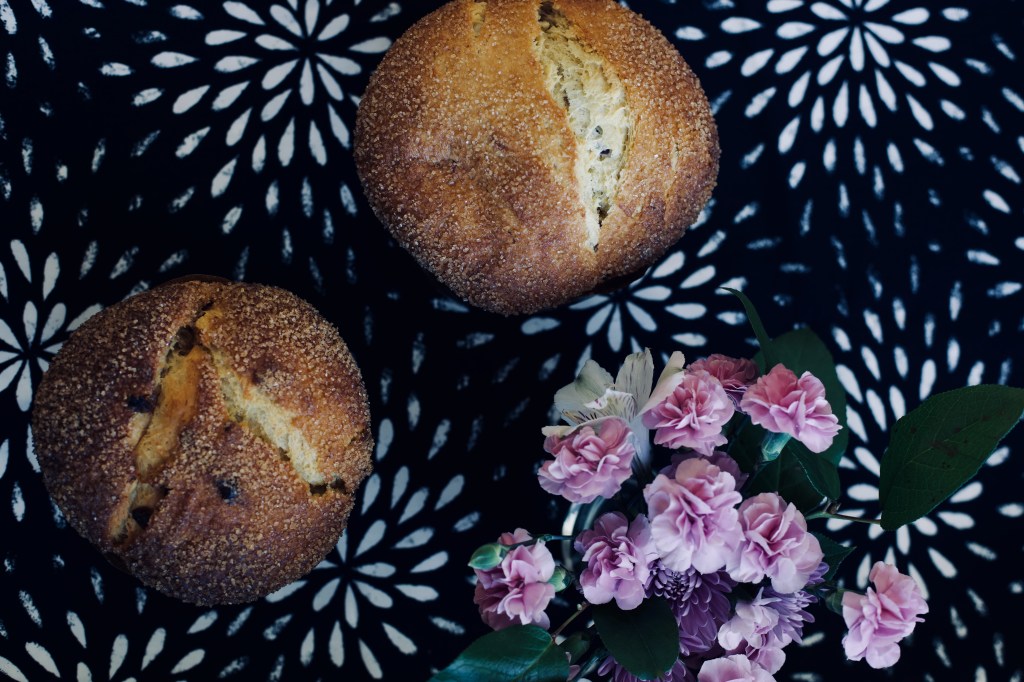
On the other end of the yeasted sweet bread spectrum, we have the panettone, packed with eggs and butter, tower tall and impossibly fluffy like a bed of soft cloud. In the south of France, it is called the brioche aux fruits, also known as the gâteau des rois, or the Twelfth-Night cake – reserved for the most festive parties of the Christmas holiday. If Marie Antoinette ever said, “let them eat cakes”, what she would have meant was, “then let them eat brioches.”
To achieve the texture of the ultimate brioche prescribes long kneading and long fermentation time, and adding tangzhong requires adjustment to the hydration percentage. The previous panettone was at 65.5% hydration, but we want it to be at least 75% using tangzhong. A lower hydration percentage would actually impede the rise, as seen with my fourth-version panettone using tangzhong. To tally up the liquid weight in a panettone, make sure to count the eggs’ liquid weight since it takes 75% their total weight. Honey doesn’t add much liquid to the bulk, but it does retain moisture. As seen with milk bread, adding 1 tbsp of honey doubles fermentation time for the first proof and improves interior moisture significantly.
King Arthur Baking Company provides a convenient ingredient weight chart on their website. We will use 10% of flour with 66% of water in weight to make the roux. This works out to be roughly 1:3 ratio of flour to water for the tangzhong. The remaining 33% of water is used in the later part of kneading. Portioning the liquid this way will roughly imitate the kneading method prescribed in the fifth-version panettone.
| INGREDIENTS | UNIT WEIGHT (GR) | TOTAL WEIGHT (GR) | % LIQUID | TOTAL LIQUID WEIGHT (GR) | HYDRATION % |
|---|---|---|---|---|---|
| Flour | 120 | 445 | 0% | 0 | |
| Water | 227 | 227 | 100% | 227 | |
| Eggs | 50 | 150 | 75% | 112.5 | |
| 339.5 | 76% | ||||
| With milk: | |||||
| Flour | 120 | 445 | 0% | 0 | |
| Milk | 227 | 255.38 | 87% | 222.18 | |
| Eggs | 50 | 150 | 75% | 112.5 | |
| 334.68 | 75% |
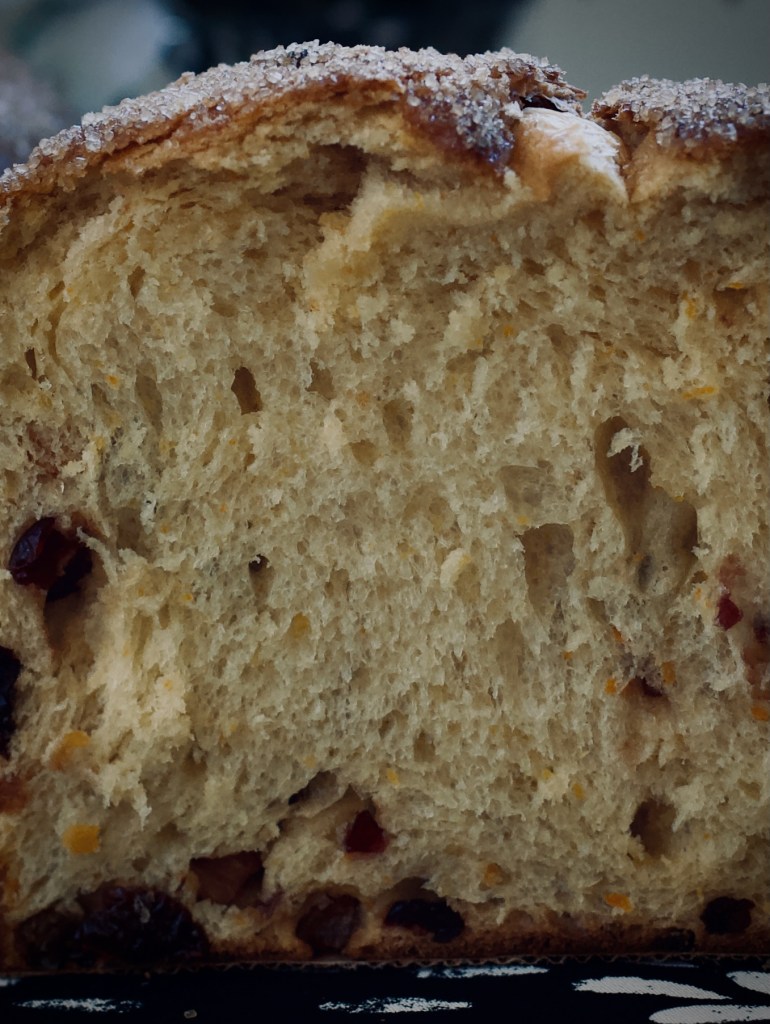
This dough, having a higher hydration percentage, rose the bread outward rather than directly upward, making a mushroom-shaped panettone. So it did not rise taller than the previous panettone. The difference was, however, super soft and moist crumb and larger air pockets. The bread was so soft that I needed to place a couple of kitchen towels inside the stockpot for support during its inverted cooling phase. It also stayed soft longer, enabled by using tangzhong as noted.
To replace water with milk needs 2 additional tablespoons of milk to reach 75% hydration, since there is only 87% liquid in milk. I found that the yeast worked much faster with milk. I ended up having to knock the bread dough down a couple of times, and then retarding it by refrigeration. The result was a more chewy loaf.
Ingredients:
Roux: ¼ cup + 2 tbsp or 45 gr flour, ⅔ cup water or milk
400 gr wheat flour, 2 tbsp orange zest
3 large eggs, room temp.
1 tbsp active dry yeast, 1 tbsp water or 3 tbsp milk, 2 tsp sugar
¾ cup sugar
12 tbsp butter, very softened but not melted
⅓ cup water or milk, 1 tsp vanilla extract, 1 tsp lemon extract, 1 scant tsp salt, 1 tbsp honey
⅓ cup golden raisins
⅓ cup sweetened dried cherries
⅓ cup sweetened dried cranberries
⅓ cup dried apricots, chopped
2 tbsp rum
Topping: raw sugar
Equipment:
Stand-mixer with dough hook attachment
Panettone molds
Skewers
Day 1:
Soak the dried fruits in rum to use on day 2.
Whisk the flour and ⅔ cup of water or milk over medium heat until forming a thick roux and let cool. Meanwhile, mix the yeast with 2 tsp sugar and 1 tbsp water or 3 tbsp milk, wait until bubbles form to ensure the yeast is active and alive.
Add to the flour the orange zest, the eggs, the yeasty liquid, and the tangzhong in the stand-mixer’s mixing bowl. Knead the flour mixture using its dough hook attachment until well incorporated, about 10 minutes. Slowly add the sugar in small increments while kneading the dough, alternating speed between 2 and 4/10, until it passes the window pane test. Be patient with kneading, as this dough is wetter and will take longer. It may take longer than 50 minutes if using water, but still roughly 50 minutes using milk.
Once the dough passes the window pane test, add to it 1 tbsp butter at a time while continue kneading. The dough should pull its strands away from the mixing bowl.
Meanwhile, mix the salt, vanilla extract, lemon extract, and honey with the remaining ⅓ cup of water or milk.
After all of the butter is added, add half of the remaining liquid. You may need to fold the liquid into the dough with a spatula in between kneading to help it along. Then add the final half of the remaining liquid, continue to fold and knead until the dough is well incorporated, soft, and smooth.
Transfer dough to a large buttered tub. Cover and let it ferment slowly. It should take between 18-24 hours for the dough to quadruple in volume. If it rises too fast, as the case with milk, refrigerate to allow for a slow fermentation.
Day 2:
Fold the dried fruits into the dough, then transfer it into one 6.75-in or two 5.25-in wide panettone molds. I was able to make one 5.25-inch loaf and nine 2.75-inch panettonetti. Cover and let the dough rise again in a warm place. I left it by the oven light bulb. It should take about 4 hours for the dough top to reach the height of the mold. It takes longer starting from refrigeration. Sprinkle with plenty of raw sugar.
Set the oven at 350F and dial it down to 325F once the loaves are in: 60 minutes for 1 large, 45 minutes for 2 smaller panettoni, 30 minutes for panettonetti.
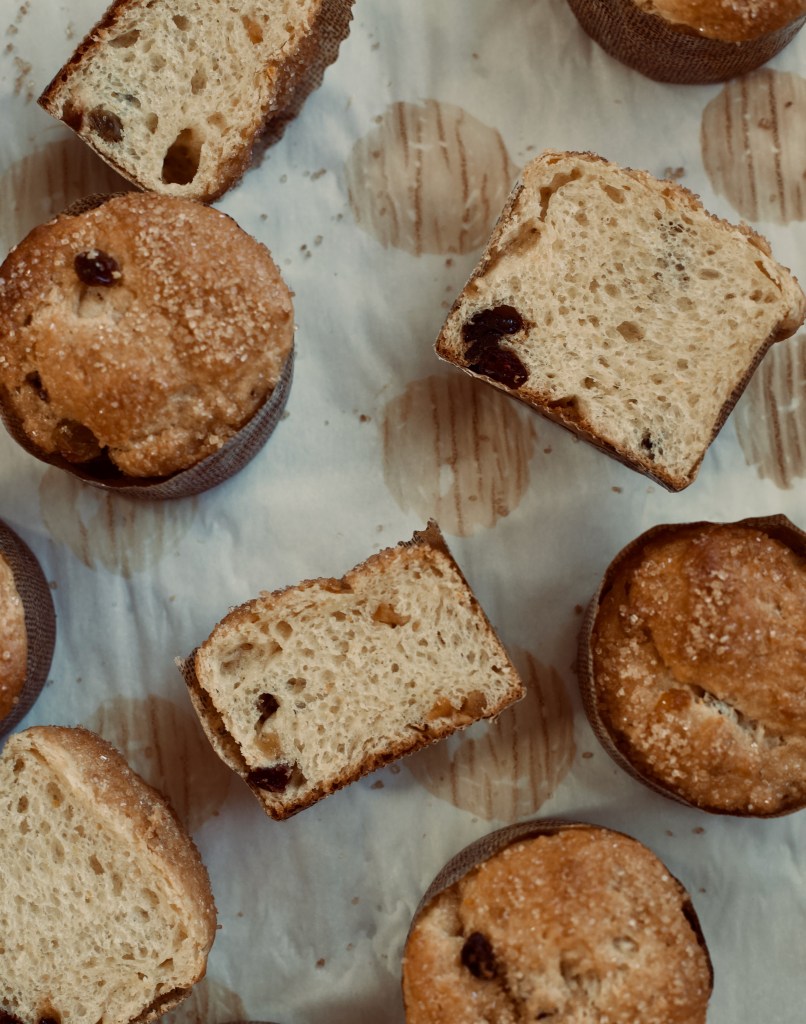
Postscript: What to do with leftover panettone? -they freeze well. Panettone ice-cream and French toast are both delicious. To make panettone ice-cream, chop the bread into bite-sized bits and toss them with a couple spoons of sugar. Toast at 400F for ~7 minutes, then add them to vanilla ice-cream along with a few spoons of citrus jam. Candied kumquats are amazing, else orange marmalade will do. Giada de Laurentiis’s panettone French toast is good. I used maple syrup instead and did not need mascarpone cheese.
 hardlyplaying.blog
One response to “Yeasted Sweet Bread: The Panettone”
[…] I learned that in order to rise a yeasted dough with large amounts of butter and sugar, such as the panettone, long kneading time to develop gluten is required before mixing in the sugar and butter. Others […]
LikeLike