
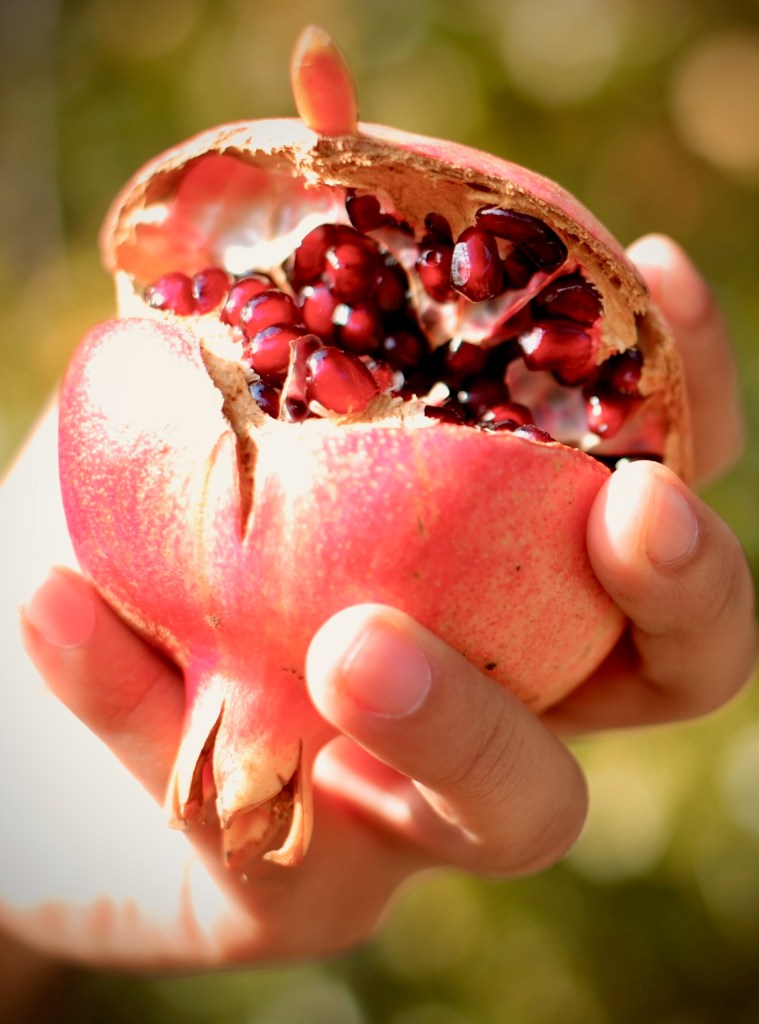
To have a pomegranate tree in the garden is to be delighted in its beauty all year. Among the first to bloom for summertime, the tree lades itself in bright red blossoms, as eye-catching as a fiery goblet upon the mantelpiece of the garden. By midsummer, flowers slowly swell into green orbs fattening up atop tutus of sepals swaddling filaments, what are left of the flower that will remain throughout the life of its fruit. Come autumn, fruits redden, every bough bends down to their weight, and the tree spreads and sags. Leaves turn bright yellow before they all fall to prepare for winter. Finally ridding itself of ripened fruits, the tree again stands upright, its naked branches fanning upward, frayed and craggy, like a giant broom spearing into the winter sky, waiting again for new buds come springtime.

Pomegranate trees tend to bear lots and lots of fruits, but harvesting them is not fun for the novice. Adapted for a desert climate, the tree’s foliage is oval and narrow, thick, and glossy, its wood dense and hard, and its branches laden with sharp spines. Its fruits are easy to rot in the rain, as water seeps in from the bottom and the ripe fruit’s cracked open skin. The grenade is aptly named after it, for the pomegranate fruit is large and heavy with tough and leathery skin. Yet once they fall onto the ground, they break open, exploding messy red juice all around. But fret not, the task becomes as manageable as tending the garden after a few cycles.
Across cultures, the pomegranate tree is associated with fertility, abundance, and good fortune. The Tree of Life, connecting all forms of creation, is often depicted as the pomegranate tree. It can also be viewed as the Tree of Knowledge, connecting to heaven and to the underworld. The pomegranate fruit has long been revered for its bleeding red juice, considered a sacred symbol of holiness. It has now been transplanted and eaten across the globe, but fermenting pomegranate juice into wine is a specialty of the Caucasus region.

To juice pomegranate, the fruit’s skin and pith must be cut away to avoid bitterness. Over numerous attempts, I have found the fastest way is to slice off the top and bottom so that it sits flat, and then run the knife along its longitudes to slice away its peel and pith, the same way one does for an orange. Then make a shallow slit in the shape of a cross atop and pry it apart by hands along the slit. The thin membranes separating clusters of arils are not bitter, so having some of them mixed in with the arils when juicing is not a problem. Juicing pomegranate can be easily done using a food processor and a muslin cloth.
Pomegranate juice smells musty with a piney-woody accent. It tastes pleasantly tart, green, and grassy. For comparison, its pH hovers around 3, while grape juice’s pH is ~3.3. When the fruit ripens and sweetens, it may be better appreciated for its balance of sweetness and sourness, but its sugar content does not alter its acidity content. The specific gravity of pomegranate juice was at 1.07, which was similar to the grape juice I pressed for my grape cider. Therefore, this would have been sufficient to make a pomegranate cider. But for this experiment, I wanted to sweeten it further in order to bring its alcohol content to that of wine. To bring its specific gravity value to 1.1, I added 2 tbsp of sugar to every cup of juice.
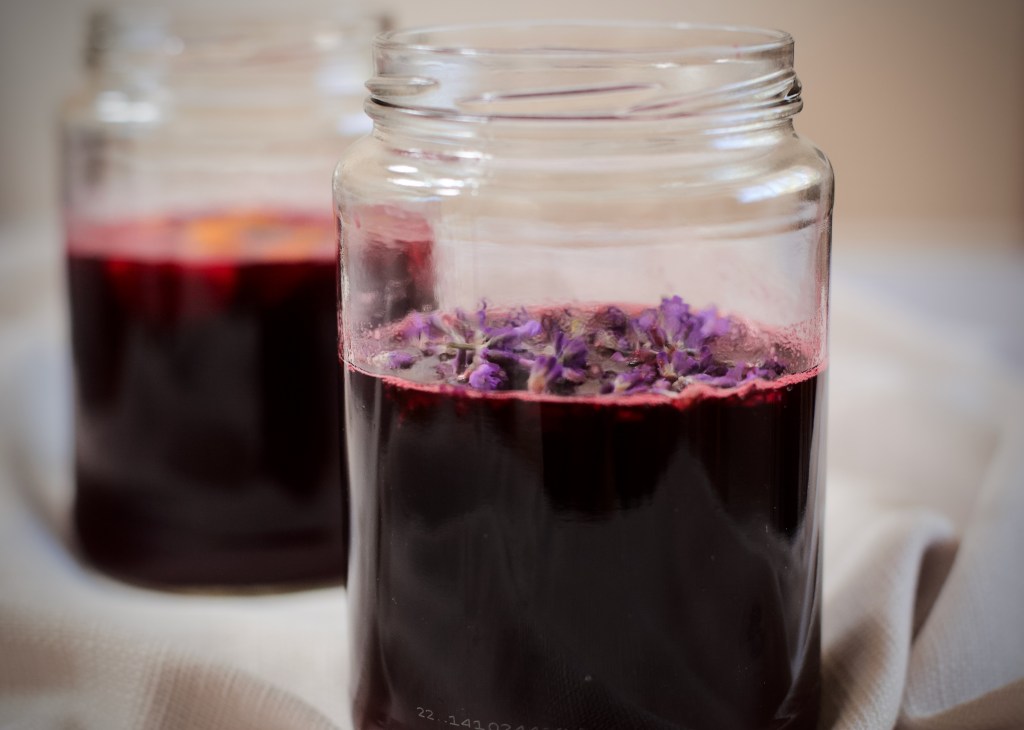
Similar to adding tea and raisin to mead, a popular way of making modern fruit wine is to flavor it with other ingredients. It can range from fragrant herbs and flowers like lavenders to fruits like kumquats. The amount of yeast and the fermentation method used are similar to grape cider. Within a day, plenty of bubbles floated atop to indicate that the yeast was active and working. After 10 days, only a few bubbles were left and I siphoned the wine into bottles, leaving the lee behind. Its specific gravity was now at FG = 1, bringing its alcohol content to %ABV = (1.11-1)/.776 = 14.2%. Its clarity was opaque, its color deep plum. It tasted reminiscent of plum peels, dry, and tart. The overall taste suggested a young wine. It smelled fruity, but not obvious of pomegranate aromas, with spicy notes of black pepper and leather. It had a short to medium finish with a tannic and tart back note. The one flavored with lavender was more bitter, and one flavored with kumquat was more tart, but I find that pomegranate wine holds plenty well by itself.
For the second batch, I pressed 2½ quart of pomegranate juice and added 1¼ cup of sugar without additional flavoring. Not 10 days, but it took a month for the yeast to digest all of the sugar. The young pomegranate wine smelled heady, of fruits and spices. It tasted dry and tart with a luscious mouthfeel.
Dry is not the only way to enjoy a fruit wine or cider. To halt fermentation to retain sweetness, cold crashing, even to freezing temperature, is employed to deactivate the yeast. But this is not easy to do for a home brewer. A surer way is to back sweeten, which is to sweeten in the glass with a tbsp of simple syrup. However, I have found that sweetening, similar to refrigeration, can dull other characters of the wine, and may actually highlight the tartness more rather than less. At the end of day, it’s your wine, so wine it your way.
 hardlyplaying.blog