
It is well accepted that the environment influences culture and language. We develop words for objects, build habits and beliefs based on the phenomena observed around us. The brain learns and forms its understanding of the world upon this information. Speech and language are so interwoven into our mind that it feels impossible to separate the two. How did thoughts or communication happen before language came about?
About the only living examples that we can observe are with babies. Newborns cry to communicate their most basic needs. Not until 3 months old can they start smiling or cooing. And not until 2 years old can they start dreaming, coinciding with the beginning development of speech and the concept of self. Children’s dreaming starts with single frames or snapshots, gradually developing into moving images and characters in action. As a bilingual, I did not learn both languages at birth, rather picking up English at 15 years old. My dreaming in English went unnoticed because it already was the primary language of my thoughts. I am able to view my thoughts independent of a language. But neither can I separate it from speech; it’s always done in one or the other language.
Our environment builds our vocabulary. We develop the most comprehensive library for that which we need most for our survival. The English dictionary possesses many a phrase to express water and bodies of water. Likewise in Alaska, there are 70 words to describe ice in the Inupiaq dialect, and the Sami language of Norway, Sweden, and Finland has 180 words related to snow and ice and 300 words for types of snow, tracks in snow, and conditions of the use of snow. From them birthed many a tale telling the lore of Nordic folks, my favorite being the story of The Snow Queen, written by Hans Christian Andersen.
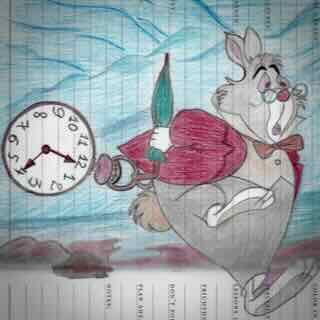
Meanwhile, the English language’s obsession with the concept of time is most perfectly embodied in the white rabbit of Lewis Carroll’s 1865 book Alice’s Adventures in Wonderland. He is always “late! For a very important date! No time to say ‘hello, goodbye,’ I’m late, I’m late, I’m late!” There are twelve different tenses within English to describe movements through time: the present simple, present continuous, present perfect, and present perfect continuous; the past simple, past continuous, and so on. Time is viewed in the same sense as space, with each preposition giving a unique position in relation to time: on time, in time, over time. Time can even be plural: at times, sometimes, all the times.
On the contrary, the past and future are expressed by adding prefixes to the present simple in Vietnamese. Certain languages, such as that of the Amazonian Amondawa tribe, exhibit no mapping between the passing of time and space. They have no word for time and refer to their ages by different statuses and stages of lives. Such mappings are not beyond their cognitive capabilities, demonstrated through their ability to learn Portuguese just fine. Yet I wonder if they would feel less anxious from not having to dwell over the past or worry about the future as much.
Why we exhibit feelings such as anxiety has long been a research subject. For a long time, much of research literature reasoned by the Darwinian premise, that they are wired into our brain for survival purposes. Yet the plethora of feelings and emotions expressed across different cultures would prove otherwise, and the latest studies about how emotions are made are telling a different story. They tell us that our sensors only communicate four basic sensations to our brain: pleasantness, unpleasantness, arousal, and calmness. It is, then, the brain that spreads these four into a spectrum of feelings using what it learns from its environment. In other words, we learn to express our feelings through observing those around us and from the culture we live in. For some, we borrow words not existing in our own language, such as schadenfreude: a German word for the pleasure derived from another person’s misfortune. Other times, we may never get a particular feeling until we see it in others and live it ourselves, such as liget, from the Ilongot tribe in the Philippines: a kind of grief that makes one howl, that runs like high voltage through the body. Do you wonder if there are yet many undefined emotions in the world? There is indeed a 10-year project attempting to define just that, which has been condensed into a book called The Dictionary of Obscure Sorrows.
When we learn another language, we do not only translate. Our brain is learning about a new people and their culture. It is comparing and contrasting between the new and old, extracting new knowledge and wisdom in the process. It is learning to express feelings and emotions, that which makes us most human.
 hardlyplaying.blog