Happiness is a popular and well-studied field in the US. As Americans, we care about our happiness a lot. The right to “Life, Liberty, and the Pursuit of Happiness” is written into our declaration of independence. We’re inclined to think that everyone else does, too, but the pursuit of happiness is not a universal pursuit. The UN declaration of human rights states that “everyone has the right to Life, Liberty, and Security of Person.” The French want “Liberty, Equality, and Fraternity”. The Germans want “Unity, Justice, and Liberty”. And the Commonwealth Nations hope for “Peace, Order, and Good Government.”
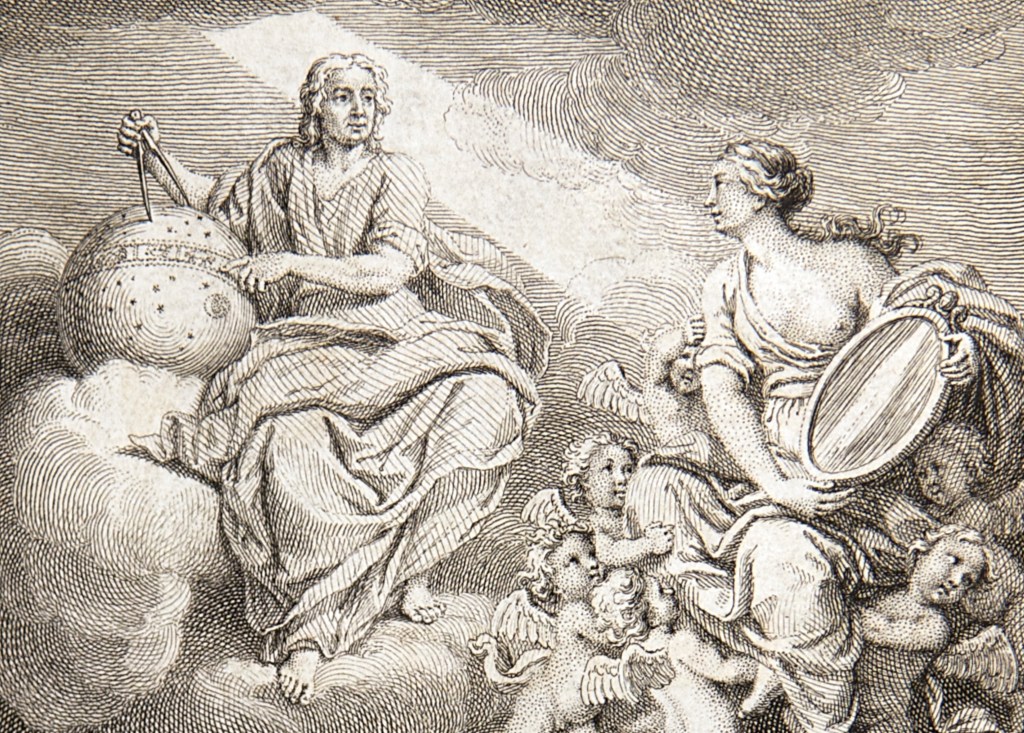
I am not a psychologist, nor am I a happiness researcher. But I’ve spent my years pondering upon my own happiness. In my early youth, it was heavily influenced by a French woman named Émilie du Châtelet. She was better known as Voltaire’s lover, but on her own merit, was a brilliant mathematician and philosopher. Her work, translating Isaac Newton’s Philosophiæ Naturalis Principia Mathematica, is still considered the standard French translation today. In his book, Elements of the Philosophy of Newton, Voltaire, being a literary rather than a scientific person, dedicated a poem to acknowledge her contributions to it. She was so much the idol to me that I had fixed my hopes and dreams for my life, if at all possible, to be like hers.
Du Châtelet wrote a book on happiness, perhaps little known outside of France. However, being her fan, I had sought it out. She outlined in it the principles required to be happy: “to be free of prejudices, be virtuous, be healthy, have good taste and passions, and believe in illusions.” Of the passions, she wrote much about the love of learning and the love for another being. On the love of learning, she wrote, “the less our happiness depends on others, the easier it is for us to be happy. … For this reason of independence, the love of learning is, of all passions, that which contributes the most to our happiness. For within the love of learning is found a passion that a noble spirit is never entirely exempt: that of glory,” which is an illusion in and of itself.
She went on to justify the love of learning to be the most important for women: “Men have endless resources to be happy that women lack entirely. They have many other means of achieving glory, and it is certain that the ambition to make his talents useful to his country and to serve his fellow citizens, either by his skill in the art of war, or by his talents for government, or negotiations, are far above that which one can offer himself for learning. But women are excluded, by their state, from any kind of glory, and when by chance, there is one who is born with a sufficiently noble spirit, there is nothing left for her but the study to console her of all the exclusions and all the dependencies condemned by the state.”
Upon the topic of love for another, she mused that “this passion is perhaps the only one that can make us want to live, and commit ourselves to thank the author of nature, whoever he is, for having given us existence. Milord Rochester is right to say that the Gods put this heavenly drop in the chalice of life to give us the courage to endure it.” Even when one’s love is not equally returned, she argued that if we let ourselves be susceptible to illusion, “the pleasure that we feel in indulging in all our tenderness may be enough to make us very happy. … It must love so much that it loves for two, and that the warmth of its feeling makes up for what is really lacking in its happiness.”
However, when love no longer serves our happiness, she advised to “cut it quickly; it is necessary to break without return. We must, says M. de Richelieu, unravel friendship and tear apart love.” For “the shorter follies are the better. They are above all the shortest misfortunes. For there are follies which would make one very happy if they lasted a lifetime. We must not be ashamed of being mistaken. We must heal ourselves, whatever the cost, and above all avoid the presence of an object that can only agitate us and cause us to lose the fruit of our thoughts.”
Du Châtelet died of childbirth at 42 years of age. Despite every limitation placed upon women of her times, it is obvious that her perspective on happiness was one of a privileged position. One may also conclude that it is a youthful point of view. As I grew older, my own view on happiness evolved, and I would find solace in another book.
Before WWII, Victor Frankl was a renowned Austrian psychologist. Upon Hitler’s invasion of Austria, Frankl obtained an immigration visa to America but let it pass unused, not wanting to desert his old parents. He wrote Man’s Search for Meaning to describe his 3 years in four concentration camps. In it, he discussed the four principle existential reflections – of suffering, of love, of life, and of mortality.
On the topic of suffering, it was considered from a temporal perspective, the temporary and the permanent, relatively speaking. In his Ethics, Spinoza wrote, “Emotion, which is suffering, ceases to be suffering as soon as we form a clear and precise picture of it.” When the suffering is momentary, one should attempt to rise above the situation and observe it as if it were of the past. However, when a man finds it his destiny to suffer, he has to accept suffering as his single and unique task. For even in suffering, he is unique and alone in the universe. No one can relieve him of his suffering or suffer in his place. His unique opportunity lies in the way in which he bears his burden.
Like other philosophers, Frankle found love to be the ultimate and the highest goal to which man could aspire. The salvation of man is through love and in love. A man who has nothing left in this world still may know bliss in the contemplation of his beloved, even if it were only a brief moment. “The angels are lost in perpetual contemplation of an infinite glory.” In utter desolation, man’s only achievement may be in enduring his sufferings honorably through loving contemplation of the image he carries of his beloved.
On the meaning of life, he proposed that what we expected from life mattered not, but rather what life expected from us. Instead of asking for the meaning of life, think of ourselves as those being questioned by life. Life ultimately means taking responsibility to find the right answer to its problems and fulfilling the tasks which it constantly sets for each individual. And because each individual differs, it is impossible to define a generic meaning of life. There is only the specific meaning of a person’s life at a given moment.
Finally, on accepting mortality, Frankl described a beautiful conversation between himself and a young woman who was to die in the next few days. She was cheerful in spite of the knowledge. Pointing through the window of the hut, she said, “This tree here is the only friend that I have in my loneliness.” Through that window, she could see just one branch of a chestnut tree, and on the branch were two blossoms. “I often talk to this tree,” She said… What did it say to her?… “I am here – I am here – I am life, eternal life.”
I have found that happiness is fleeting. We carry every other emotion with us throughout our days. They make us into human beings. They are substances of life, a reminder that we are alive. To reprise Spinoza, what matters is to be able to rise above our emotions in order to observe them objectively. I once read an Oatmeal comic about how to be perfectly unhappy, for in our unhappiness, may we find curiosity, fascination, entrancement, and meaning.
 hardlyplaying.blog