

This year, I signed myself into the pro-probiotics camp. As they are the bacteria intended to do amazing things for your gut, probiotics are the golden child of the wellness movement. Thanks to their supreme popularity of late, there is a plethora of fermented tea products, aka kombucha, available at your grocery store. Since all of them are flavored with passion fruits, tangerines, and the like, it dawned upon me that I didn’t know what the original kombucha tasted like.
Although kombucha originates from East Asia, I was not aware of it until fairly recently. Its origin is attributed to China, but the name kombucha itself is Japanese. However, it is a misnomer, since kombu means kelp, thus kombucha means kelp tea and not fermented tea. Its alternative name is fungus tea, also incorrect because no fungus is involved in the fermentation process. It is claimed that the fermented tea spread to Russia as kvas. However, I am uncertain how accurate this is, because kvas is a fermented drink made from bread and brewer’s yeasts, which is used in wine, beer, and bread making in Europe since ancient times, whereas kombucha is made from tea and a very complicatedly named colony, Symbiotic Culture of Bacteria and Yeast, acronymed SCOBY.
Well, I’m into fermentation and I’m pro-probiotics, and making my own kombucha promised to be a great fun experiment. Like other fermentations, practicing cleanliness and sterilizing all equipment with boiling water prevents harmful bacteria from growing. Otherwise, the process to fermenting kombucha is fairly straightforward. All required are brewed tea, sugar, the SCOBY, and some starter kombucha. The SCOBY purchased comes with its starter tea. The typical amount of sugar used is 5 – 10% of the liquid by weight.
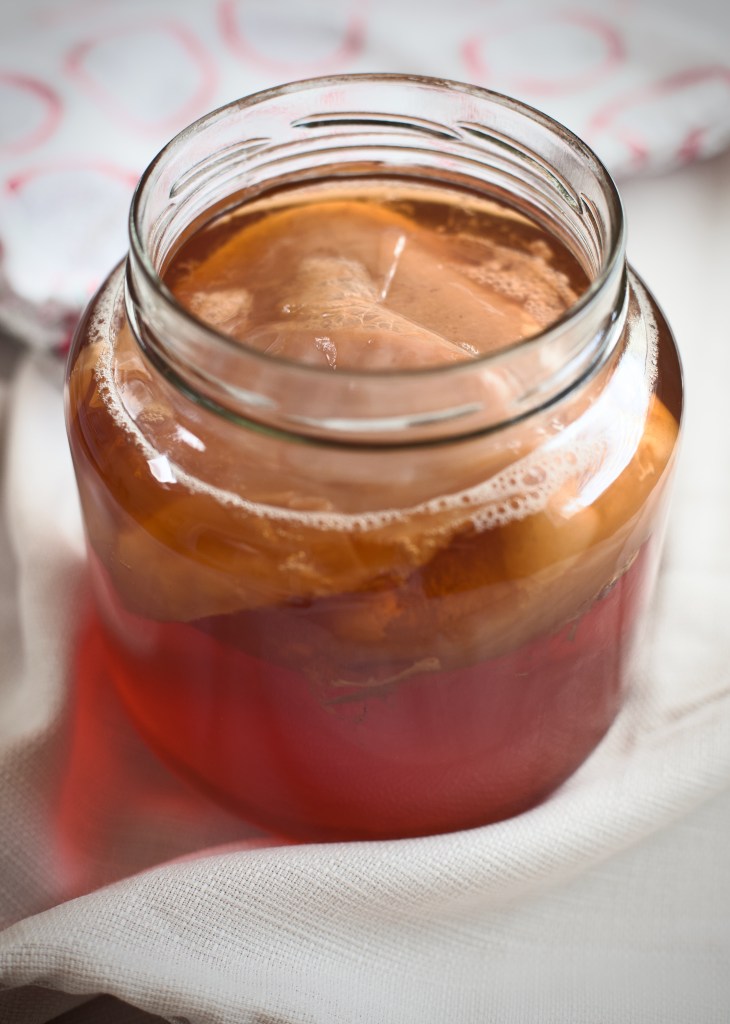
1 quart or 1 liter of water
2 tbsp of granulated tea, black or green
¼ cup – ½ cup sugar
1 palm sized SCOBY with starter kombucha, about ¼ cup
Bring the water to a boil and add the tea granules to let steep for 10 minutes. Then filter the tea, add sugar to dissolve, and let it cool down to room temperature, about several hours. Add the cooled brewed tea to a sterilized container and add the SCOBY and starter tea. Like other fermentations, only use glass, ceramic, or food-grade plastic, and not metal containers. For the first couple of cycles, a glass or plastic container is useful in order to observe the fermentation progress. This is an aerobic fermentation which requires oxygen, thus the container can be covered with a linen cloth to let air pass through.
The SCOBY is similar to a vinegar mother. It digests sugar and turns it into acetic acid and carbon dioxide, giving it a tingly mouth feel. As sugar is its main food, even herbal tea will work. During fermentation, the tea and its SCOBY smell very much like vinegar, but the tea, once extracted, is milder. Any additional flavor is included during the second stage of fermentation after bottling. Extra sweetener can be used during this stage for extra carbonation. Once the fermented tea is bottled, sweetened brewed tea is again added to start the next batch and to keep the SCOBY alive and growing it.
Due to safety concerns, there is research looking into microbial and chemical activities during kombucha fermentation. I tracked my fermentation progress and also observed that the tea tasted “off” after 4 days, likely caused by acid shock per reporting. Aside from the presence of acetic acid which inhibits microbial development, the inhibitory effect increases with the concentration of tannins in tea. Therefore, herbal tea may be fine for fermentation, but brewing real tea is safer.
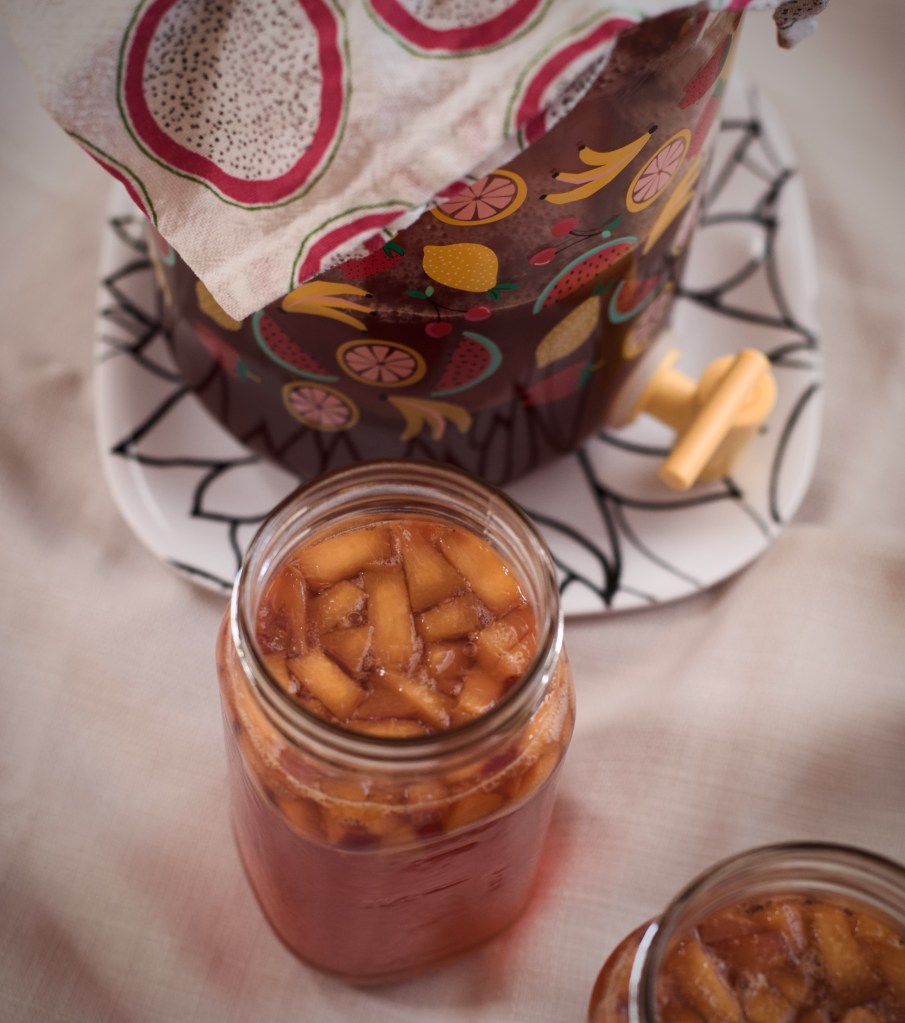
Fermenting kombucha in a container with a bottom tap is convenient with respect to bottling and also saving a portion of the tea as the starter for the next batch. Start tasting after 4 days and extract once it is to your liking. It is typically ready for bottling after 7 days. Kombucha without additional flavors is like sweetened diluted vinegar. With respect to health benefits, I think it should be comparable to drinking apple cider vinegar.
 hardlyplaying.blog