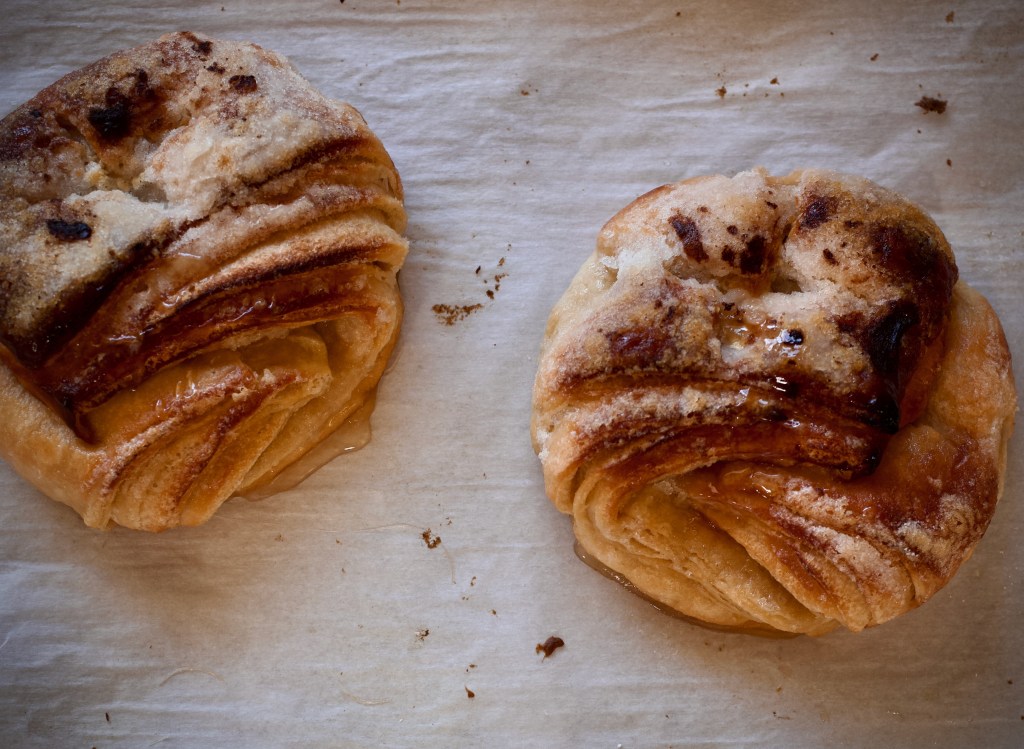
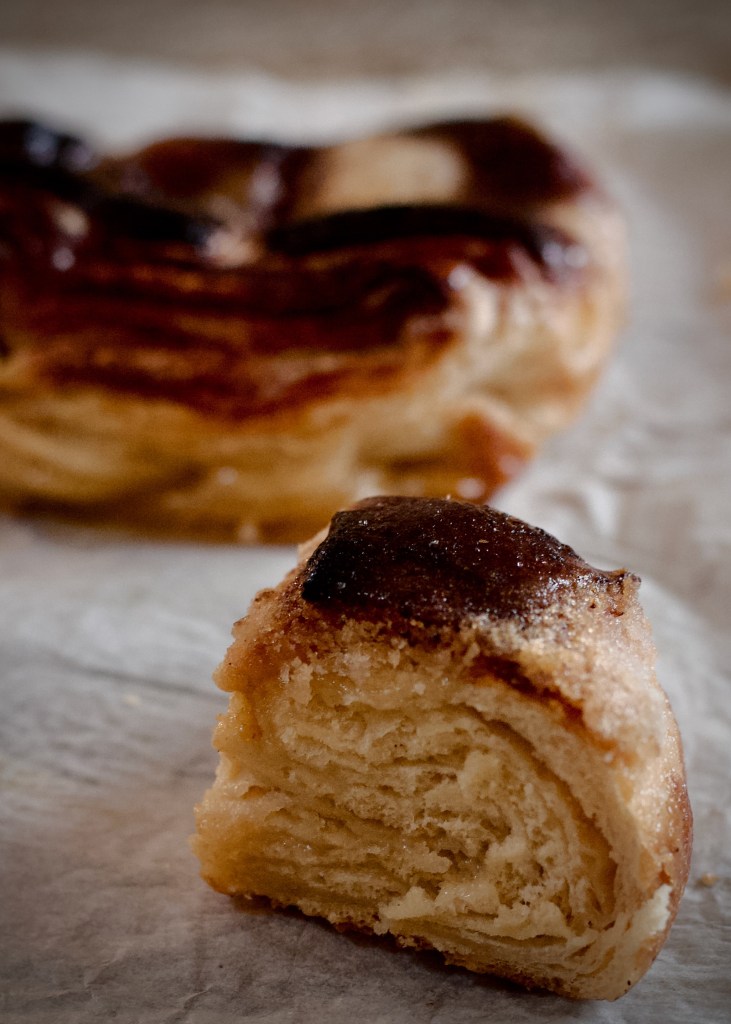
I think of the kouign-amann as a decadent croissant – caramelized, sweet, flaky, and buttery. It is extraordinary that so much sugar and butter could be stuffed inside a yeasted wheat dough to rise into a layered and puffy pastry.
In the realm of yeasted sweet bread with large amounts of butter and sugar, such as the panettone, long kneading time to develop gluten is required before mixing in the sugar and butter. Others such as the cardamom bun incorporate both butter and sugar at the end by spreading on butter just before the final rise, then further sweetened after baking.
Like the croissant, the kouign-amann works by lamination, adding butter and sugar in between dough layers. There are two methods to adding sugar: incorporate it into the butter before lamination, tagged METHOD 1, or sprinkling it onto the dough at the final stages of lamination just before the final rise, tagged METHOD 2. If using METHOD 1 to mix sugar into the butter, I found it best to perform all lamination before the overnight cold rest. Moisture and heat generated by the yeast digesting the dough turn some of the sugar into syrup, making the final tourage on DAY 2 to be a messy attempt. Fortunately, the kouign-amann is forgiving in that unlike the croissant, it does not need to be rolled out and shaped into crescents, and then risen into perfect-looking honeycombs. This allows for a higher hydration percentage with a lower fat level while keeping a portion of the fat and sugar to caramelize its crust. Whereas the croissant was at 60% hydration and 29% roll-in butter, for the kouign-amann, the détrempe is at 66% hydration and roll-in butter percentage by total weight comes in at roughly 25%.
| INGREDIENTS | UNIT WEIGHT (GR) | TOTAL WEIGHT (GR) | % LIQUID | TOTAL LIQUID WEIGHT (GR) | HYDRATION % |
| Flour | 120 | 240 | 0% | 0 | |
| Water | 227 | 85.13 | 100% | 85.13 | |
| Milk | 227 | 85.13 | 87% | 74.06 | |
| 159.18 | 66% | ||||
| Roll-in Butter % of Total Weight | |||||
| Butter | 113 | 141.25 | |||
| Flour | 120 | 22.5 | |||
| Total Weight | 574 | ||||
| Butter % | 0.246 |
Otherwise, with METHOD 2, all of the sugar can be used on DAY 2 and the dough can be worked just like a croissant dough. Done this way, it rises taller with a lighter and more tender texture, but lacks the rustic flavors of the traditional METHOD 1.
Pâte à Kouign-Amann:
Détrempe
1½ cup flour
1 tsp salt
¼ cup + 2 tbsp water
– Pouliche:
1 tsp active dry yeast
½ cup flour
1 tbsp sugar
½ tsp molasses
¼ cup + 2 tbsp warm milk
Beurrage
1 stick + 2 tbsp cold butter
½ cup sugar
3 tbsp flour (for American butter)
DAY 1:
Détrempe: Repeat the steps for détrempe in croissant.
Beurrage:
Using the fraisage technique to soften the cold butter, slice the butter into tablespoons and smear each across the countertop with the heel of your hand. Use the dough scraper in your other hand to gather the butter together after each time you finish pushing it across the counter.
METHOD 1: when the butter is malleable, work the ½ cup of sugar and flour into the butter using the same technique. Gather and repeat until it is smooth and homogeneous. Wrap in parchment paper and refrigerate until it is as firm as the détrempe, at least 30 min.
METHOD 2: repeat the steps for beurrage in croissant while reserving the ½ cup of sugar for the final tourage on DAY 2.
Tourage:
METHOD 2: repeat the steps for tourage in croissant. Wrap the paton in cling film and refrigerate overnight after 2 turns.
METHOD 1: repeat the steps for tourage in feuilletage for a total of 4 turns with a 15-minute freeze rest in between 2 turns. Dust with extra flour if needed and no worries if the dough tears in spots. With the addition of sugar, the butter block’s volume has about doubled while the détrempe remains the same. Even though the additional sugar makes it more difficult to work the paton, the kouign-amann is forgiving in that unlike the croissant, it does not need to be rolled and shaped into crescents at the end.
After the last turn, halve the paton, and make two slashes for a deep cross shape atop each. Shape and divide the paton so that the divided portions almost fill the bottom of the baking pans. When the dough rises and enlarges, it should fill the bottom of the baking pan, so as to prevent too much sugar and butter from puddling underneath instead of being absorbed into the dough. Place into 2 lined 6-in round baking pans (line parchment paper to the top edge only; it must not touch the top of the oven; it will catch on fire), cover with cling film, and refrigerate the entire assembly.
DAY 2:
Need: ¼ cup of sugar for sprinkling atop, 2 tbsp of melted butter.
METHOD 2: complete the final 2 turns while spreading on ¼ cup of sugar at each rollout, totalling to ½ cup of sugar.
Halve the paton and place it into 2 lined 6-in round baking pans (line parchment paper to the top edge only; it must not touch the top of the oven; it will catch on fire). Shape and divide the paton so that the divided portions almost fill the bottom of the baking pans. When the dough rises and enlarges, it should fill the bottom of the baking pan, so as to prevent too much sugar and butter from puddling underneath instead of being absorbed into the dough. Make two slashes for a deep cross shape atop each.
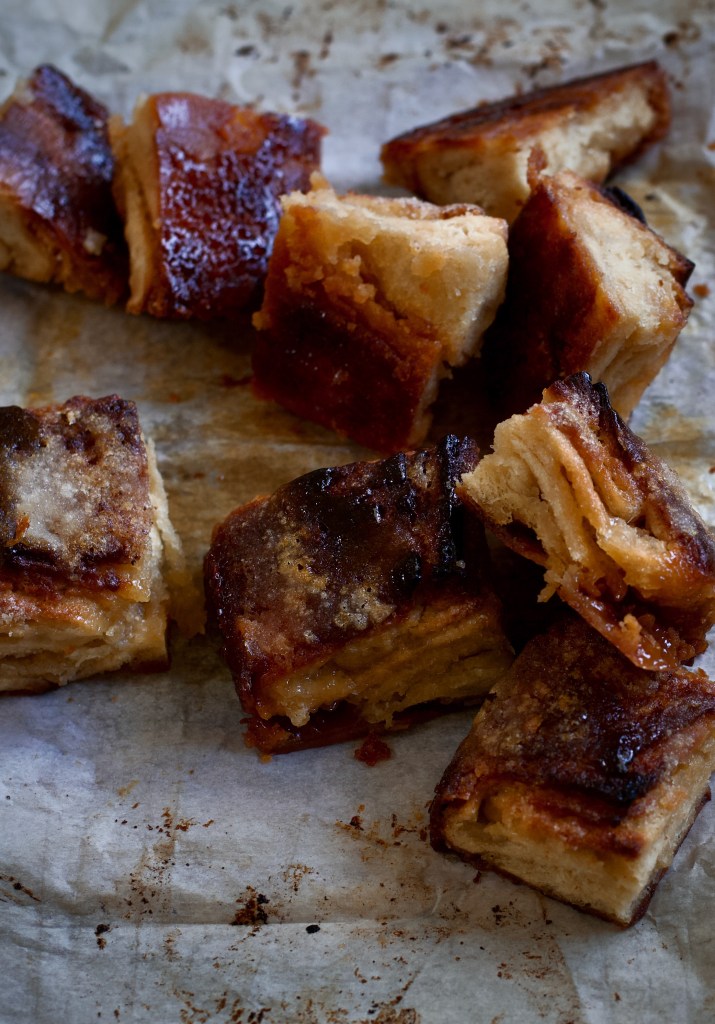
For both methods, cover loosely and let the dough rise for 2-3 hours in a warm corner, e.g. in the oven with the oven light on for 30 minutes, then turned off. It should be puffed with separate layers. Drizzle on the melted butter and spread the remaining ¼ cup of sugar atop. The extra butter and sugar syrup will puddle at bottom and caramelize. Set the oven to 400F, then reduce to 375F once the dough is in; 30 minutes for 2 larger cakes until golden brown and the sugar is caramelized.
 hardlyplaying.blog