
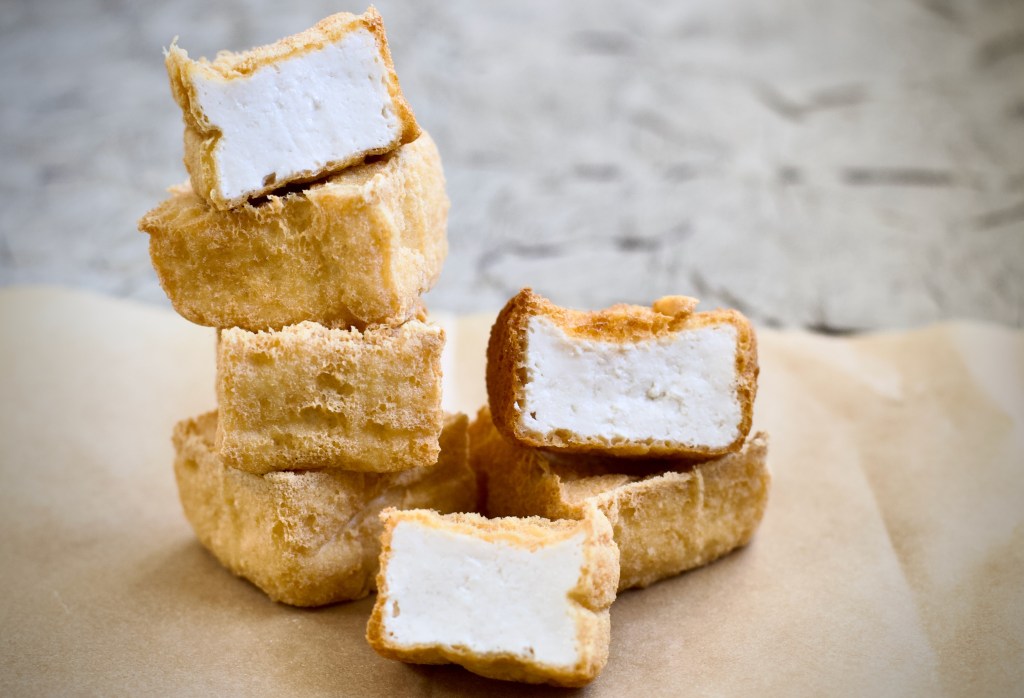
I’ve been keeping on with my tofu experiment, because the fat lady hadn’t sung yet. Using soured cheese water, aka fermented cheese whey, should have gotten me to a tofu texture closer to the tofu made with GdL. Surprisingly, it yielded an extra firm tofu instead. Furthermore, varying the salt level did not give a more desirable texture. After the fourth batch, I experimented with ¼ tsp of salt for the same soured cheese water, which made a medium-firm tofu, but neither creamy nor soft.
Adding soured cheese water to the tofu whey was equivalent to adding a mother of whey, thus my tofu whey was able to ferment. After 24 days, the tofu whey tasted slightly sour, but with a salty note. I kept the ratio of salt to soybeans to water the same – ½ tsp salt : 6 oz soybeans : 8 cups of water. It churned out very soft curds and it did not appear that the curds were completely separated from the whey.
After 30 days, the tofu whey now tasted like cheese whey fermented after 16 days. This is an inaccurate way to describe it, as it’s entirely dependent on my taste bud. This tofu whey made similar tofu texture as the tofu made with GdL – crisp and golden exterior, soft and creamy interior. I measured their pH levels using litmus paper strips. Meyers lemon’s pH level was at about 3. Freshly made tofu whey was at about 6. However, using litmus paper was not accurate enough to measure a “just right” pH value. For the tofu whey, it showed a pH value of 5 for a wide range from mild, ideal, to excessive acidity level.
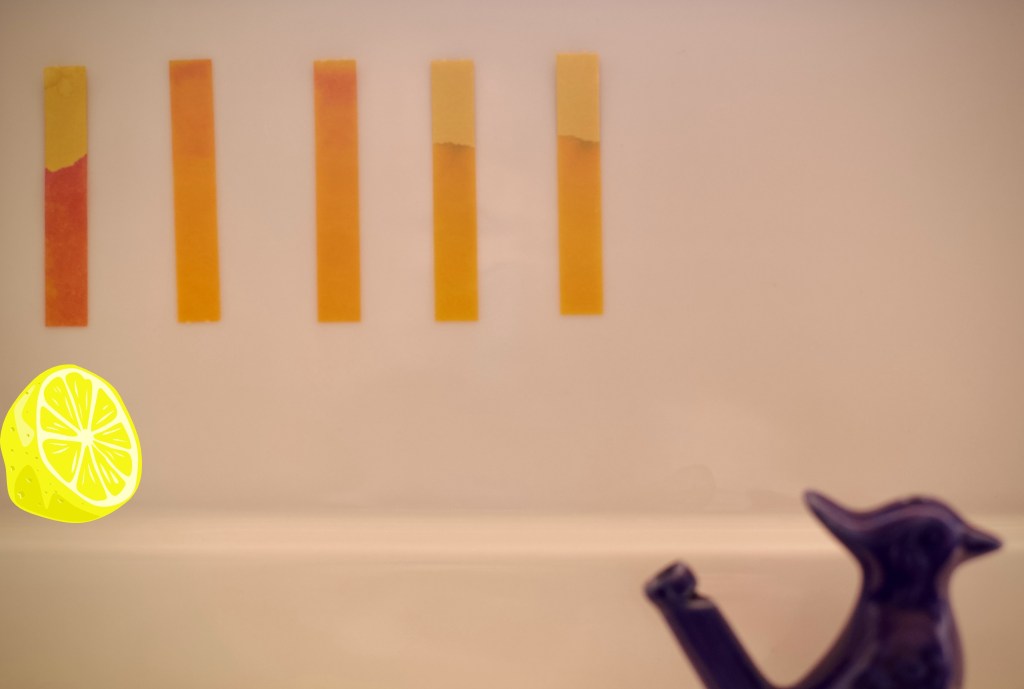
I thus invested in a pH meter for more accurate measurements. I found that to make tofu needed a pH level of 3.9. To track tofu water’s pH values from fresh to sour, the following approaches were devised, which generated four different samples:
- Use soured cheese water to make tofu, then add to the fresh tofu whey two different starters: ~20% soured cheese water and ~20% soured tofu water.
- Use soured tofu water to make tofu, then add to the fresh tofu whey two different starters: ~20% soured cheese water and ~20% soured tofu water.
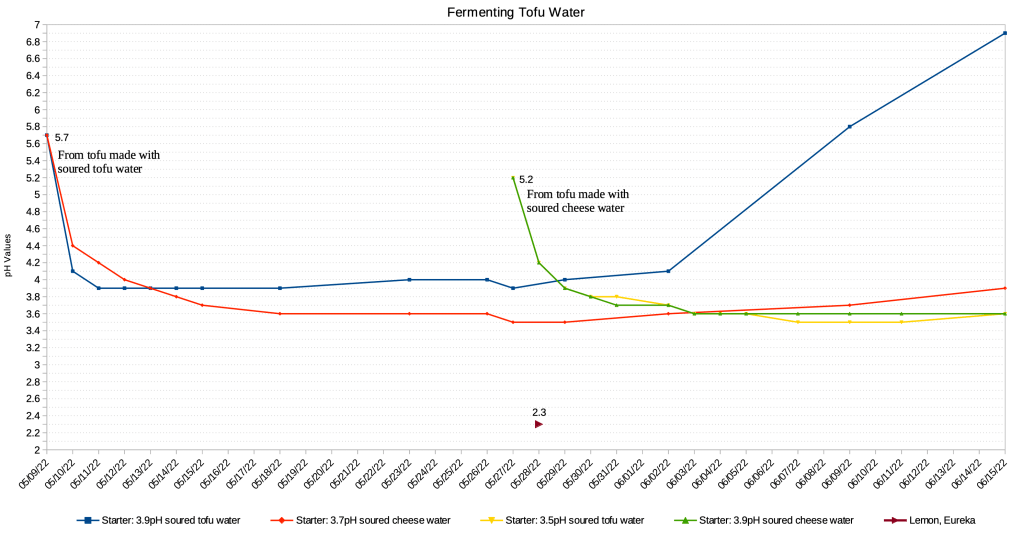
Both starters appear to have gained strength after several souring cycles. At the beginning of the experiment, it took a month for fresh whey to become sufficiently acidified. However, it now takes roughly 4 days for fresh whey to reach 3.9 pH.
Observations:
1. To make tofu for frying, soured tofu water at 3.9 pH gives the softest and creamy interior with a crisp and golden exterior. It takes ~18 tbsp of soured tofu water for 6 oz soybeans : 8 cups water : ½ tsp salt.
2. Cheese whey can ferment by itself, but tofu whey needs a mother of whey, aka a starter. Soured cheese water can be used as the starter for tofu whey. Ambience temperature, the strength of the soured whey, and the ratio of soured whey to fresh whey all affect souring speed and strength. Using ~20% starter, it takes ~4 days for the fresh tofu whey to reach 3.9 pH. Attaining a lowest pH value depends on the starter’s strength, but they don’t appear to dip below 3.5 for tofu whey fermented with either soured cheese water or soured tofu water.
3. Keeping the amount of salt constant, the soured whey’s acidity affects the tofu texture in an unexpected way. More sour or lower pH whey makes firmer tofu texture. However, if it’s not sour enough, the curd does not coagulate completely and thus cannot form tofu.
4. Not all soured whey are created equal, even at the same acidity level. Using soured cheese water at 3.9 pH makes fresh tofu whey at 5.2 pH, whereas using soured tofu water at the same pH makes fresh tofu whey at 5.7 pH. This difference in pH level explains the difference in the final tofu’s texture profile. At a higher pH level, tofu made by soured tofu water is creamier and softer than the tofu made by soured cheese water.
5. Once soured tofu water reaches minimum pH value, it remains at this level for some time before climbing back up. As its pH level increases, the whey’s color transitions from off white – light yellow hue to a dark yellow – light brown hue.
 hardlyplaying.blog
One response to “Fermenting Tofu Water”
[…] Note: Within 2 days, there should be frothy bubbles atop. Gradually, the soybean should smell pungent like a funky cheese. Use a glass jar to take advantage of sunlight. Per my observation, the soybean did not ferment properly in the ceramic jar. Rather than smelling funky, it smelled like soured tofu water. […]
LikeLike