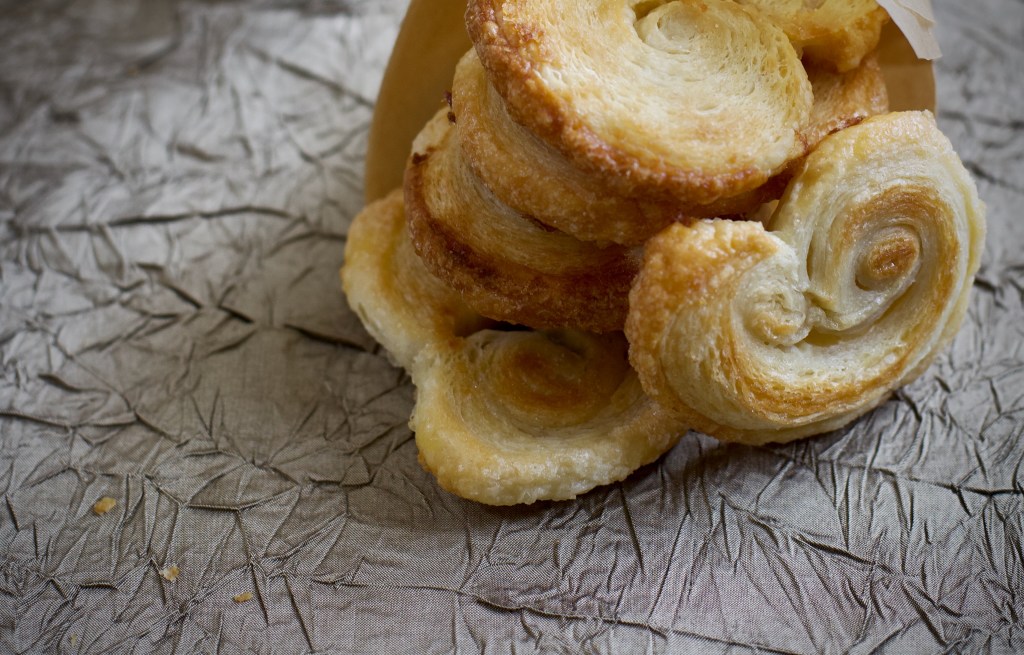
I’m talking about flakes of butter marbling a slab of pastry dough for delectable puff pastries. Only simples ingredients, mostly flour and butter, but with proper techniques and time, will create light and airy pastries like palmiers and croissants or a flaky and scrumptious crust base for pies and tarts.
Techniques – because making puff pastry is methodical. It is laid out in three phases. The first phase is détrempe, meaning tempera, a method of painting where pigments are dispersed in an emulsion miscible with water. Thus in détrempe, flour is mixed with water and other components to create the dough.
The second phase is beurrage, or buttering. In beurrage, the butter is worked to obtain the same firmness as the détrempe so that both can be rolled out together. It also needs to be sized so that it can be enveloped by the détrempe. When using butter with a higher water percentage, such as American butter, extra flour is typically incorporated into the butter to absorb the extra moisture.
To soften the butter, we use a technique called fraisage, meaning to mill. In fraisage, use the heel of your hand to smear the butter across the countertop, then gather and repeat until it is smooth and homogeneous. This technique can also be used in the détrempe to smear the butter into the flour to make a pie crust.
The third phase is tourage, or turning. In tourage, the dough is flatten and folded again and again so that it is laminated with layers of dough strewning among layers of butter.
Time – because in between every step requires ample cold resting to prevent the butter layers from melting into the flour. Layers of butter interspersing layers of dough is how we achieve a puffy and flaky pastry. It takes 30 minutes of refrigeration to firm the butter again each time after it’s worked and an overnight rest for the water to distribute into the flour evenly, allowing enzymes to break down proteins and starches, thus for the dough to develop flavor and texture. All together, it is a total of 2 days to go from flour to pastries.
It depends what goes into the détrempe that determines the pastry. A basic détrempe enveloping a butter block are for cookies such as palmiers and papillons. Alternately, incorporating the butter into the détrempe while omitting beurrage makes pie crust. Finally, adding yeast to ferment the détrempe makes croissants.
Feuilletage – Flaky Cookies

Adapted from Mastering the Art of French Pastry by Healy & Bugat
Détrempe
2 cups AP wheat flour
1 tsp salt
½ heaping tsp of vinegar (to prevent gluten from developing too much strength)
½ cup + 1 heaping tbsp ice water
2 tbsp butter, cold
Beurrage
1 stick + 6 tbsp butter, cold
¼ cup AP wheat flour (for American butter)
DAY 1:
Détrempe:
Stir the salt into 2 cups of flour. Cut the butter into small pieces and rub them into the flour with your fingers until it resembles cornmeals.
Dissolve the vinegar into the water, add it to the flour, and mix gently with your hands until it makes a rough dough.
Turn the dough onto a surface and knead it with your hands until it’s smooth and has developed some gluten, 2-3 min.
Pat the dough into a 4-inch square, wrap in clingfilm, and refrigerate for at least 30 min.
Beurrage:
Using the fraisage technique to soften the cold butter, slice the butter into tablespoons and smear each across the countertop with the heel of your hand. Use the dough scraper in your other hand to gather the butter together after each time you finish pushing it across the counter.
When the butter is malleable, work the flour into the butter using the same technique. Gather and repeat until it is smooth and homogeneous. Wrap in wax paper and refrigerate until it is as firm as the détrempe, at least 30 min.
Tourage:
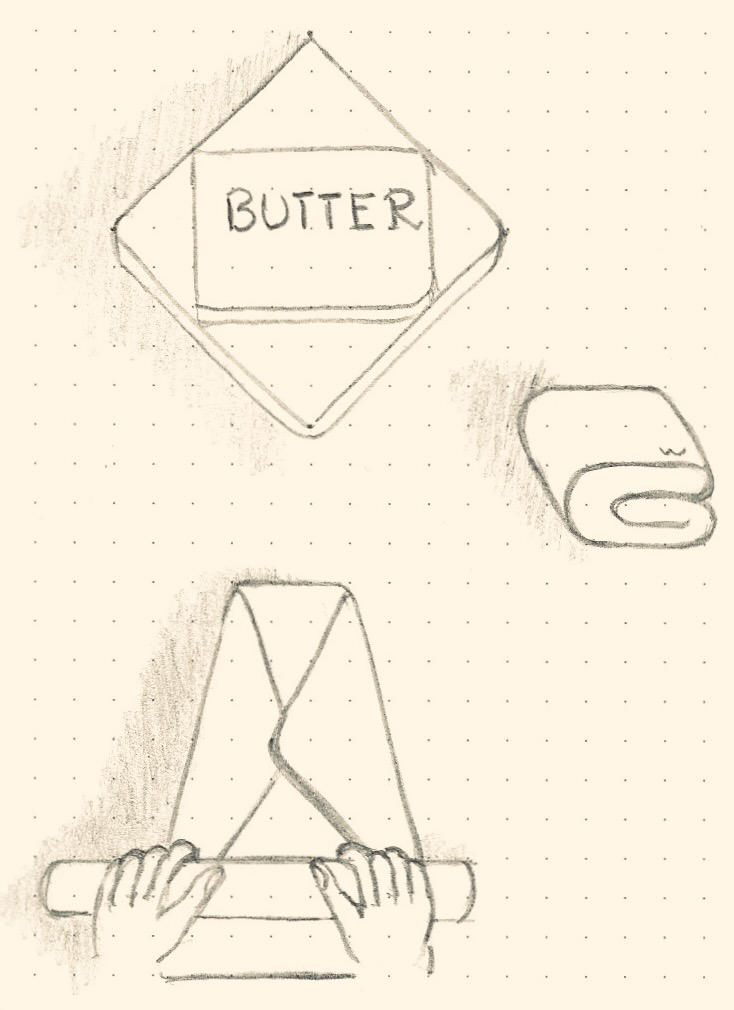
Place the square of détrempe onto the countertop. With the heel of your hand, press out four corners from the ball of dough to make a square with a mound in the center. Then roll the rolling pin over the corners to thin them and enlarge the square. Orienting on the diagonal with respect to the square of détrempe, roll the rolling pin over the central mound to make a cushion.
Place the butter on the square cushion of détrempe. Ensure the remaining four triangle areas of the détrempe are large enough to envelope the butter. If it isn’t, remove the butter block and roll out the corners again to enlarge it. Fold each corner of the détrempe to completely cover the butter block. Seal the envelope by pressing on it with the heel of your hand, then use the rolling pin to flatten it into a square. This is called a paton. Wrap the paton in clingfilm and refrigerate for 30 min.
Have the paton in the direction perpendicular to the last envelop fold of the détrempe. Roll out the paton into a rectangle three times the original length. Use Shirley Corriher’s “brush-it-with-ice-water” technique before folding to create greater puff and also to keep the dough soft and easy to roll. Fold in three like a letter fold. This is the first turn. Rotate the paton 90 degrees so that the edge of the dough where the layers are visible faces you. Repeat the steps for rolling, ice-water brushing, and folding. This is the second turn. Wrap in clingfilm and refrigerate for at least 30 min, preferably 2 hours.
Give the paton 2 more turns. Wrap in clingfilm and refrigerate overnight, up to 3 days. This dough freezes well for a month. Defrost overnight in the refrigerator before using.
DAY 2:
Need: egg wash (1 egg + 1 tbsp milk) and ¼ cup of sugar for dusting.
Give the paton 2 final turns, dusting the countertop and the dough with sugar to prevent sticking. Don’t forget to brush the dough with ice water before each fold. Refrigerate for 30 min, then roll the paton into a long and flat rectangle. Dust counter and rolling pin with sugar as needed.
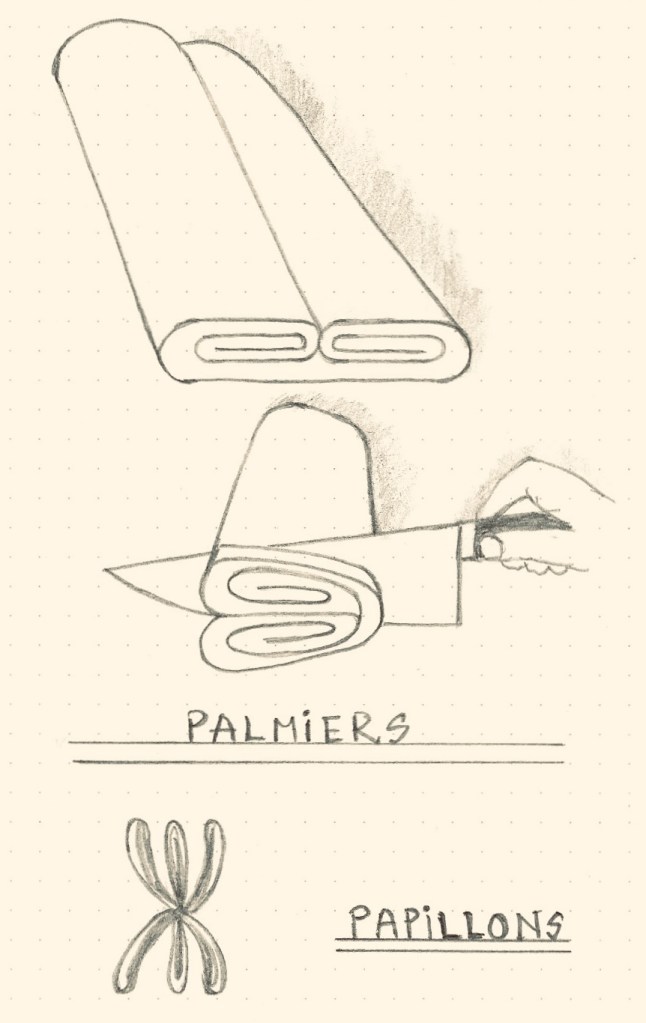
To make palmiers – palm leaves cookies: Fold two short edges of the rectangle toward and a little short of half way to the centerline, like folding a book jacket. Brush the centerline with egg wash, then fold the two short edges again, this time meeting at the centerline.
Brush one half with egg wash, then fold it over the other half. Dust with sugar, then roll the rolling pin over it to press the layers together to flatten and elongate the dough.
Use a chef knife to cut into slices 1.5 cm thick. Place them 3 inches apart on a prepared baking tray. Freeze for 15 min or refrigerate for 30 min.
To make papillons – butterflies cookies: Cut the large rectangle into 3 equal rectangles. Press the center of a sheet with your finger to make an indentation and brush the indentation with egg wash. Place the next sheet on top and repeat to seal all the sheets together. Dust the sheets with sugar and gently roll parallel to the indentation to thin the pile.
Use a chef knife to cut into ½-inch wide strips perpendicular to the indentation. If the strips are short, as mines were because I divided the dough in half to make both palmiers and papillons, gently pull the strip on both ends to elongate and thin the center. Pinch the strip center, then take the ends of the strip and give a half twist. Place them 2 inches apart on a prepared baking tray. Press the center of each strip down with fingertip and gently push the three layers of each end together. Freeze for 15 min or refrigerate for 30 min.
Oven to 425F. Once the cookies are in, reduce the oven temperature to 400F, 12 min until lightly golden at the bottom. Turn the cookies, reduce to 350F, another 20 min until medium caramel colors with golden center.
You can see that the palmier design is easier to make, whereas my papillons look like twist ties. Regardless, they were both scrumptious.
 hardlyplaying.blog