
Unless tofu is life, one would think it too much effort to ferment soy whey just to make tofu. But in East Asia, soy is life; as in elsewhere, cow milk is life. Just as folks have devised myriad ways to process cow milk, others have accumulated knowledge over millennia to turn soybeans into soy milk, soy sauce, tofu, miso, and countless other soy products. Each culture then further refines their techniques to suit their own environment and culinary habits.
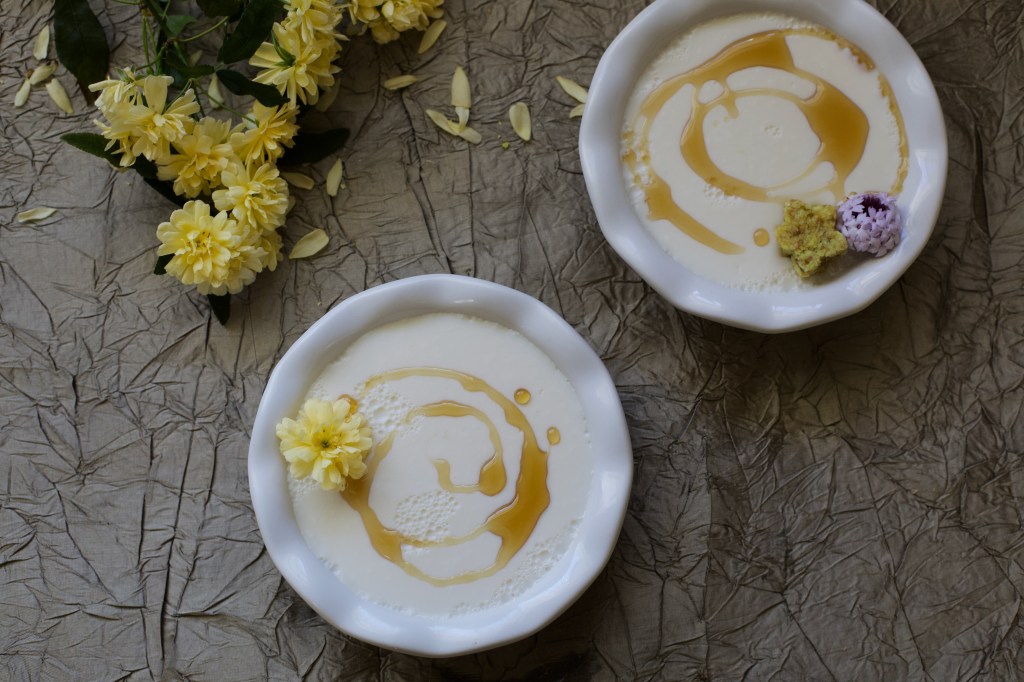
On the other end of the tofu spectrum, there is silken tofu – soft, creamy, and custardy like panna cotta. Eaten with ginger syrup, it is a popular sweet treat. Paired with yuzu lemon and soy sauce, it takes on a savory flavor. Nigari and gypsum can both be used for silken tofu, but the best one is made with glucono delta-lactone (GdL), a fermentation-based mild acidifier.
When added to an aqueous solution, GdL rapidly dissolves and then slowly hydrolyses to gluconic acid, thus producing a gentle acidification like natural fermentation. This property makes it an outstanding acidifier compared to other acidulants, which tend to provide instantaneous acidification. Unlike nigari or gypsum which makes spongy or crumbly curds, GdL produces smooth and uniform texture, most desirable in silken tofu. GdL also gives the most neutral flavor, being one-third as sour as citric and lactic acid, such as lemon juice and fermented whey, and ¼ as sour as acetic acid, such as vinegar. [source: Jungbunzlauer]
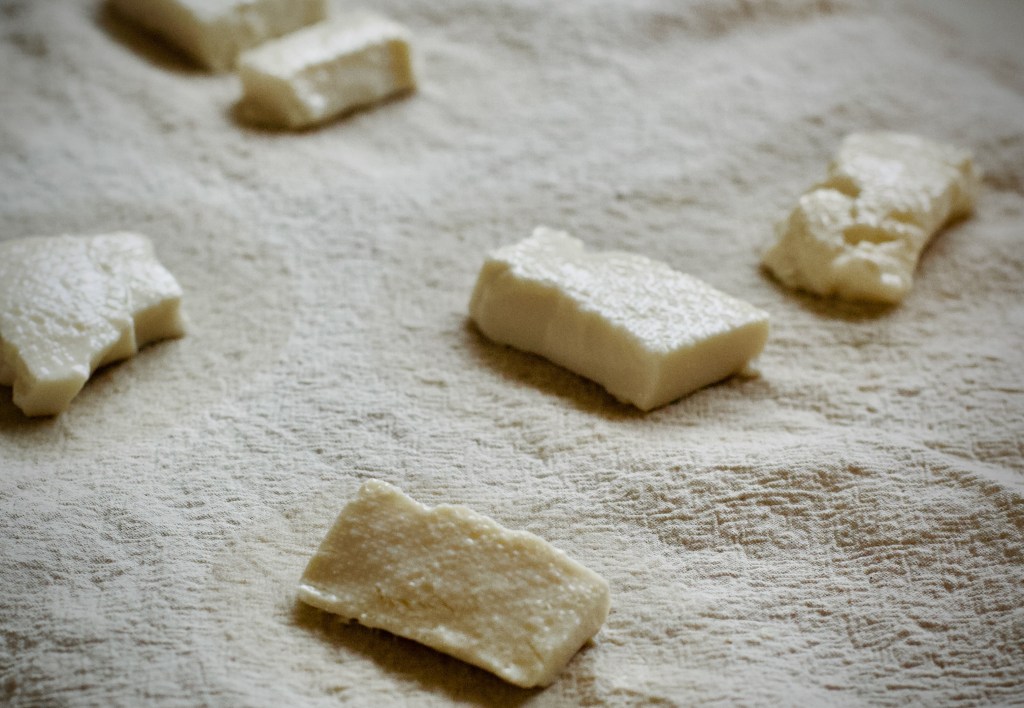
I made silken tofu following the recipe from Jungbunzlauer, but found it weeping – too much whey was being separated from the tofu. To stabilize it, a tiny amount of thickening agent such as cornstarch is added. To make curded tofu, ½ tsp of salt is the magic number for 8 cups of water and 6 oz of soybeans. This exact amount of salt binds the soybean mass into a thick paste and will require strong hands to churn out 6 cups of thick soy milk. To make silken tofu however, adding ¼ tsp of salt makes around 7 cups of good tasting soy milk.
For 4 cups of soy milk, whisk together ½ tsp of GdL, ½ tsp of corn starch, and 1½ tbsp of water in a large bowl. Prepare all your molds before hand because once the soy milk is mixed into the GdL solution, it will coagulate within a few minutes. Bring the soy milk to steaming heat but not boiling, then pour it into the GdL solution, then pour it again into your molds. Do not touch for at least one hour to let it set. For a firmer silken tofu, leave it refrigerated for a few days, covered with a new paper towel daily to allow for moisture to evaporate.
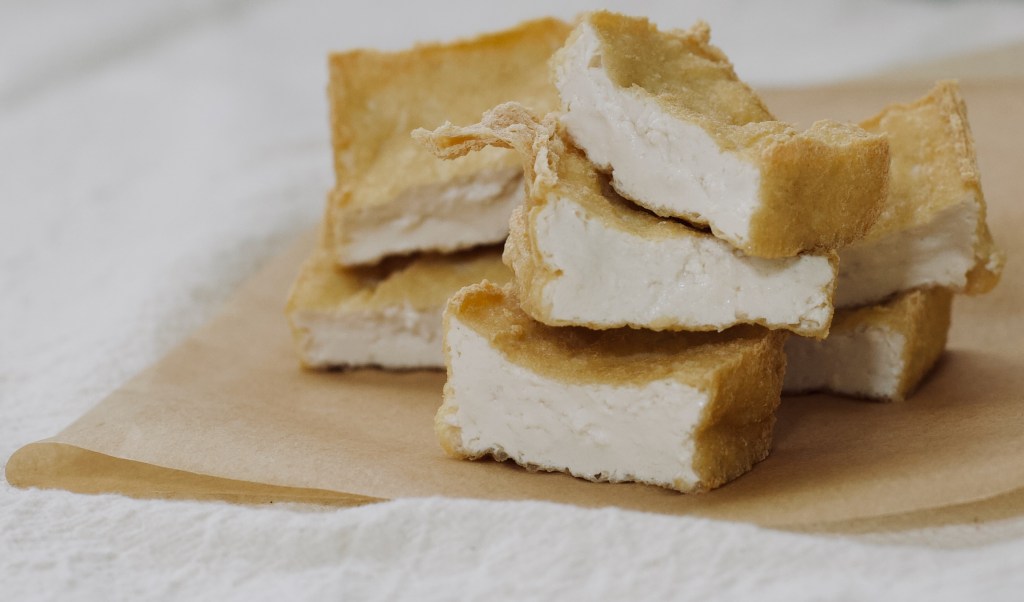
I made curded tofu with GdL, and it was my best version yet. 8 cups of water and 6 oz of soybeans with ½ tsp of salt made 6 cups of soy milk. I curdled 4 cups of this soy milk with ½ tsp of GdL dissolved in ½ cup of water. Using a 4×5.5-inch mold, a 28-oz weight and 15 minutes later, this amount of tofu curds allowed me to achieve a wide and flat tofu slab. The fried tofu had a crispy, lightly golden, and even textured exterior with a soft and creamy interior, most closely resembling the tofu of my nostalgia. These standard plastic tofu molds are not costly, so one could also purchase several for 6+ cups of soy milk, which is what I plan to do.
My next favorite way to fry tofu is batter-fried silken tofu. Its high water content does not make it suitable for frying by itself. But using a starch to coat creates a crisp exterior while protecting the tofu’s texture. I like potato starch, as corn starch creates a brittle and thick layer, while tapioca starch makes a chewy one. Silken tofu is ultra moist, so make sure to dry before coating.
And when I’m hardly playing, I count on store-bought silken tofu for frying, for soup, for mapo tofu, or just simply zested with yuzu and soy sauce. For me, it is the workhorse of tofu, gifting me with time to devote to all things non-tofu.
 hardlyplaying.blog
One response to “Silken Tofu”
[…] cheese water, aka fermented cheese whey, should have gotten me to a tofu texture closer to the tofu made with GdL. Surprisingly, it yielded an extra firm tofu instead. Furthermore, varying the salt level did not […]
LikeLike